Few people are as vulnerable to fraud as someone who badly needs a job. Scammers know this, and fake job offers have become one of the most common cyber-frauds in India, targeting freshers, women looking for work from home, and people hoping to work abroad. The good news is that fake offers follow patterns that you can learn to spot.
The 10 warning signs
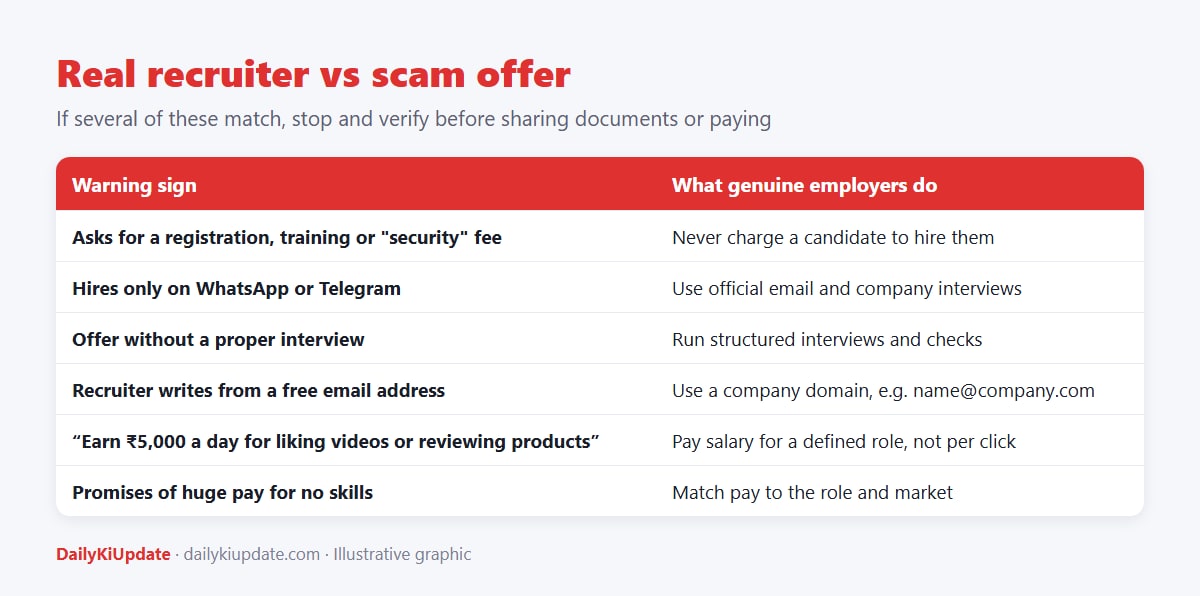
- You are asked to pay. A genuine employer does not charge for registration, interview, training, uniform, laptop, "security deposit" or visa processing (in the case of a valid overseas job, only regulated fees through proper channels apply). This is the number-one sign.
- The whole process is on WhatsApp or Telegram. A real company has official emails, an HR team, a careers page and structured interviews.
- The offer comes too quickly. You get a selection message without an interview, or after a five-minute chat for a high-paying role.
- The recruiter uses a free email address such as Gmail, Yahoo or Outlook, or a look-alike domain with a small spelling change.
- The pay is unrealistic for the work: high pay, no experience, no skills, work from home, "just 2 hours a day".
- It is a "task" job. You are asked to like videos, rate products or complete small online tasks for per-task payment. After a few small payouts, you are asked to deposit money to "unlock" larger earnings, and then the money vanishes.
- They ask for sensitive information early, such as Aadhaar, PAN, bank passwords, OTPs, a photo with your ID or a UPI PIN. You may share documents after a verified offer, but never OTPs or PINs.
- The company details do not check out. No office address, a brand new website, copied logos, or no trace on the company's genuine careers page.
- The offer letter looks wrong. Spelling errors, a generic template, no company registration details, no named signatory, or a letter that arrives before any interview.
- You are pressured. "Pay in the next two hours or the seat goes", "this offer is only for you", or "do not tell anyone".
How to verify an employer in 10 minutes
- Go to the company's official website yourself by searching its name. Do not click links in messages. Check its careers page for the same job.
- Check the recruiter's email domain against the company website.
- Call the company's official number from its website, and ask HR to confirm the job and the recruiter.
- Check the company's registration on the Ministry of Corporate Affairs website (mca.gov.in) using its company name or CIN, in the master data search.
- Search the company name with words like "scam" or "fraud", and read reviews on company-review sites, remembering that reviews can be faked too.
- Check the recruiter on LinkedIn. Look for a genuine profile with connections, history and a link to the company page.
- Ask a trusted person to look at the offer before you pay or share any documents.
Special warning: jobs abroad
Overseas job fraud ruins many families. For jobs abroad, check that the recruitment agent is registered with the Ministry of External Affairs' Protector of Emigrants through the eMigrate system. For certain countries and job categories, emigration clearance rules apply. Never pay a large amount to an agent who is not registered, and never travel on a visit or tourist visa for a job. Keep copies of your contract and verify the employer abroad.
Government job offers
Government recruitment is done through official notifications on the department's website, written exams and interviews. No genuine department sells jobs for money, and no one can "fix" a government job. If someone promises one for a fee, it is a scam. You can browse official openings on the National Career Service portal and the official sites of the recruiting bodies.
If you have already paid or shared details
- Stop all payments and do not send "one last fee" to recover the first one.
- Call 1930, the national cybercrime helpline, immediately. Speed gives a better chance of freezing the money.
- Report on cybercrime.gov.in with the transaction IDs, screenshots of chats, offer letters, phone numbers and website addresses.
- Tell your bank and ask them to flag the transaction. Block your card or UPI if needed.
- Change passwords and PINs if you shared any, and remove any app they asked you to install. See our phone security checklist.
- If you shared Aadhaar and ID details, check what is registered in your name through Sanchar Saathi.
- File a police complaint and keep the acknowledgement.
Similar pressure tactics are used in the digital arrest scam. In both, the scammer tries to rush you and keep you from talking to anyone.
Frequently asked questions
Is it normal to pay a registration fee for a job?
No. Genuine employers do not charge candidates. Be careful with agencies that charge for "placement" and check what they actually deliver.
Are work-from-home typing or data entry jobs real?
Some are, but a large number of such ads are scams that charge a "registration" or "software" fee. Verify the company, and never pay.
Can a company verify me by asking for my Aadhaar?
After a verified offer, an employer may need ID proofs for onboarding. Share copies only, never OTPs, and only with a verified company.
What is the cyber crime helpline number?
1930. You can also report at cybercrime.gov.in.
How can I check if a job post on a portal is real?
Cross-check on the company's own careers page, and apply there if possible.