Resignation is one of the few career moments where how you leave matters almost as much as why you leave. A clean exit protects your reference, your relieving and experience letters, and the money you are owed, which includes gratuity, leave encashment and your last month's salary. This guide covers the steps in the order you will face them.
Before you resign: 6 checks
- Have the new offer in writing. Do not resign on a verbal promise. Check the joining date, designation and salary in the offer letter.
- Read your appointment letter. Look for the notice period, buyout terms, bond or training-cost recovery clauses, and the non-compete or non-solicitation clauses.
- Check pending dues. Note your leave balance, bonus or incentive eligibility dates, and variable pay rules. Some companies pay a bonus only if you are on the rolls on a specific date.
- Back up personal items, such as your own payslips, Form 16, appraisal letters and performance reviews. Do not copy confidential company data.
- Tell your manager first, ideally face to face or by call, before the formal email. Do not let them hear it from HR.
- Do not resign in anger. Industries are smaller than they look, and a reference check is common.
Resignation letter sample
Keep it short, polite and factual. You do not need to explain your reasons.
Subject: Resignation: [Your Name], [Employee ID]
Dear [Manager's Name],
I am writing to formally resign from my position as [Designation] at [Company Name]. As per my contract, my notice period is [60] days, and my last working day will be [date].
I am grateful for the opportunities and support I have received during my time here. I will do my best to ensure a smooth handover of my responsibilities and am happy to help train my replacement during the notice period.
Kindly let me know the formalities I need to complete.
Regards,
[Your Name]
[Employee ID] | [Contact Number]
Send it by official email, keep a copy, and ask HR to acknowledge it in writing.
How notice periods work
- Length: the notice period is whatever your contract says. In the private sector it commonly ranges from 30 to 90 days, with more senior roles often longer.
- Serving it: you are expected to work normally and hand over your tasks. You cannot usually use leave to shorten it unless HR agrees.
- Buyout: many contracts allow you to pay (or have the new employer pay) the salary for the remaining notice days to leave earlier. The employer is not always obliged to accept, so check the clause and ask in writing.
- Waiver: some employers waive part of the notice period at their discretion.
- If the employer asks you to leave earlier, ask what is payable for the unserved days.
Gratuity: the formula and an example
Gratuity is a lump-sum payment to employees for long service, covered by the Payment of Gratuity Act in establishments where it applies. As a general rule it is payable after five years of continuous service, though it is also payable earlier in case of death or disablement. The formula is:
Gratuity = Last drawn monthly salary (basic + DA) × 15 ÷ 26 × number of completed years of service
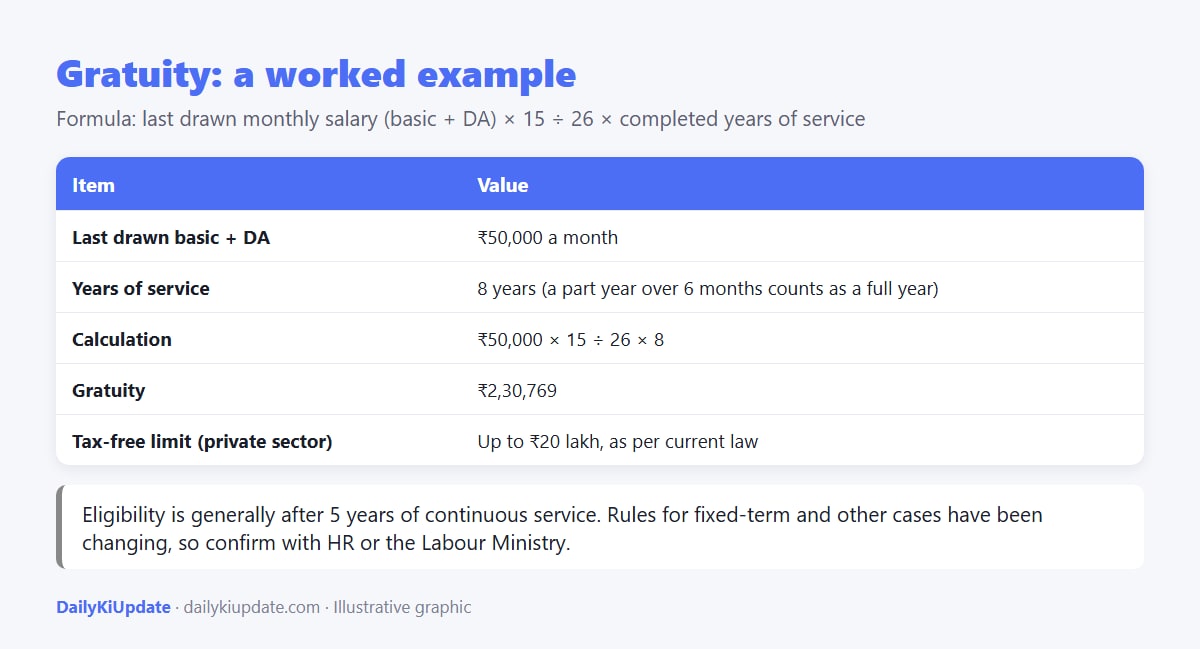
For example, with a last drawn basic plus DA of ₹50,000 and 8 years of service (a part year of more than six months is generally counted as a full year), gratuity is ₹50,000 × 15 ÷ 26 × 8 = ₹2,30,769. Gratuity received by private-sector employees is tax-free up to ₹20 lakh, as per the current rules. Labour law reforms have been updating the eligibility rules for categories such as fixed-term employees, so check the latest position with HR or the Ministry of Labour and Employment.
Full and final (F&F) settlement checklist
After your last working day, the company calculates what you are owed and what you owe. It usually includes:
| Item | What to check |
|---|---|
| Salary up to the last day | Pro-rata salary for the days worked |
| Leave encashment | Unused leave eligible under company policy |
| Bonus or incentives | As per the plan terms and the date rule |
| Gratuity | If you have completed the required service |
| Deductions | Notice-period shortfall, loans, advances, unreturned assets, training bond |
| Provident Fund | Not part of F&F, but you should file the transfer or withdrawal claim on the EPFO portal using your UAN |
Many companies settle F&F within 30 to 45 days, depending on policy, although rules and practice vary. Ask HR for the timeline in writing, and keep the settlement statement.
Exit checklist
- Handover document with project status, passwords to be changed, ongoing tasks and key contacts.
- Return laptop, ID card, access cards and other company assets, and get an acknowledgement.
- Collect the relieving letter, experience letter, final payslips and, later, Form 16.
- Update your UAN with the new employer's PF details, and transfer the PF online instead of withdrawing, to keep your retirement savings growing.
- Say your goodbyes professionally and connect with colleagues on LinkedIn. See our guide on building a LinkedIn profile.
Common mistakes
- Resigning verbally and not on email.
- Badmouthing the company in the exit interview, on social media or to a client.
- Joining a competitor in violation of a clear, enforceable clause, without checking.
- Leaving without the relieving letter. Many new employers insist on it.
- Assuming the buyout is automatic.
Frequently asked questions
Can an employer refuse my resignation?
Generally, an employee can resign by serving the contractual notice. An employer can ask you to serve the full notice period, but it cannot force you to continue working indefinitely. Disputes depend on your contract and law.
Can I resign during probation?
Yes. The probation notice period is usually shorter. Check your letter.
Do I get gratuity if I leave before five years?
Generally no, except in cases like death or disablement, or where the law or your contract allows an earlier payment.
How long does the relieving letter take?
Usually after F&F clearance, in a few weeks. Follow up politely.
Should I accept a counter-offer?
Think about why you wanted to leave. A raise rarely fixes issues such as growth, manager or culture.
Sources to verify
- Ministry of Labour and Employment: gratuity and labour law updates
- EPFO: UAN, PF transfer and withdrawal
- Income Tax Department: tax treatment of gratuity and leave encashment
General information, not legal advice. Check your own contract and company policy.