In India, many people accept the first offer because negotiating feels rude or risky. In most cases a polite, well-prepared conversation is a normal part of hiring, and recruiters often expect it. Done well, it can add a significant amount to your salary, and the effect compounds because future raises are usually a percentage of today's pay.
This guide covers preparation, the words to use, what to ask for apart from salary and how to read a CTC so you know your real take-home.
Step 1: Do your research
- Market range: check salary data on job portals, company review sites and from people in similar roles. Treat the numbers as a range, not a promise, as they are self-reported.
- Your value: list your skills, results and the specific problem you will solve for this company.
- Your numbers: know your current CTC, fixed vs variable, notice period and the lowest offer you would accept. Never lie about your current salary. Companies can verify through payslips or background checks.
Step 2: Understand CTC before you compare offers
CTC (cost to company) is the total the employer spends on you in a year. It is not what you receive in your bank account. A typical CTC includes:
- Basic salary, often 40% to 50% of CTC. PF, gratuity and some other items are calculated on it.
- HRA (house rent allowance), partly tax-exempt in the old regime if you pay rent.
- Special or other allowances, the flexible balance.
- Employer's PF contribution, usually 12% of basic, which goes to your PF account and not your bank account.
- Gratuity provision, which you receive only after the required years of service.
- Variable pay or bonus, which is not guaranteed. Find out how much is fixed.
- Insurance and perks, such as group health cover, which are valued in the CTC even if you may never use them.
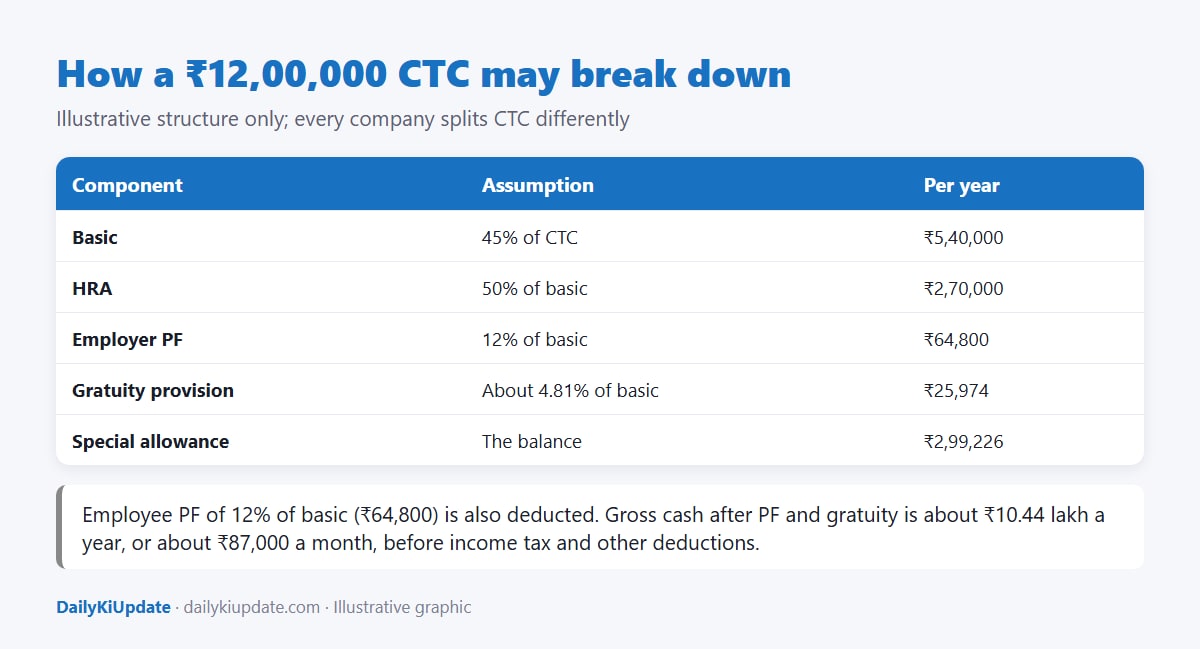
Example: ₹12,00,000 CTC
| Component | How calculated (illustrative) | Per year |
|---|---|---|
| Basic | 45% of CTC | ₹5,40,000 |
| HRA | 50% of basic | ₹2,70,000 |
| Employer PF | 12% of basic | ₹64,800 |
| Gratuity provision | About 4.81% of basic | ₹25,974 |
| Special allowance | Balance | ₹2,99,226 |
| Total CTC | ₹12,00,000 |
Deduct the employer PF and gratuity provision (₹90,774) and the employee's own PF (₹64,800) and you get about ₹10.44 lakh a year, or about ₹87,000 a month, before income tax, professional tax and any insurance deductions. See our income tax slab guide to estimate the tax on top. Two offers of the same CTC can have a very different monthly in-hand, so ask for the full salary structure in writing.
Step 3: Time the conversation right
The best time to negotiate is after you have the offer and before you accept it. Avoid naming a number early if you can. If asked about your expectation in the first call, you can say: "I would like to understand the role and the range for this position first. I am sure we can find something fair."
Step 4: What to say, with scripts
When you receive the offer
"Thank you for the offer. I am excited about the role and the team. Based on my experience with [specific skill or result] and the market range for this position, I was expecting something closer to ₹[X]. Is there flexibility on the fixed component?"
When they say the budget is fixed
"I understand. Could we look at other parts of the package, such as a joining bonus, an earlier review at six months, or a larger fixed share?"
When you have another offer
"I have another offer at ₹[X], but this role is my first choice because of [real reason]. If you can come closer to that figure, I would be glad to accept."
Only mention a competing offer if it is true. Keep the tone warm, give a reason, and stay silent after you ask. The pause is part of the process.
What else to negotiate besides base pay
- Joining bonus or relocation support
- Notice period buyout by the new employer
- Fixed vs variable ratio
- Review date after six months
- Designation or title, which affects your next job
- Work flexibility, such as hybrid or remote days
- Learning budget for courses and certifications, see our guide to free courses
- Health insurance for your family, and ESOPs for startups, with the vesting terms in writing
Offer letter checklist before you resign
- Designation, salary structure and joining date
- Probation period and notice period during and after probation
- Variable pay rules, payout timing and any clawback
- Bond, training cost recovery or non-compete clauses
- Background verification terms and what happens if the offer is withdrawn
- Written confirmation of all verbal promises
Once you are sure, follow our resignation guide.
Common mistakes
- Comparing CTCs without checking what is fixed and what is variable.
- Accepting on the phone before seeing the written offer.
- Giving a false current salary.
- Making threats or ultimatums.
- Negotiating only with money in mind when growth, manager and learning matter as much.
Frequently asked questions
How much hike is reasonable when changing jobs?
It depends on the role and market. Instead of a fixed percentage, anchor to the market range and your value.
Can an offer be withdrawn if I negotiate?
It is uncommon if you are polite and reasonable. Be prepared for the answer "no" and decide in advance what you will do.
Should freshers negotiate?
Campus offers are often fixed. Off-campus offers sometimes allow some room. You can still ask politely.
What is a good fixed-to-variable ratio?
It depends on the role. Sales roles have more variable pay. For most other roles, a higher fixed share gives more certainty.
What is the difference between CTC and gross salary?
CTC includes employer-side costs like PF and gratuity. Gross salary is what is paid before deductions.
Sources to verify
- EPFO: PF contribution rules
- Income Tax Department: HRA and tax rules
- National Career Service: official career resources
Illustrative figures only. Your company's structure will differ.