There is no such thing as a "digital arrest" in Indian law. The CBI, police, customs, the Enforcement Directorate and the courts do not arrest people over a video call, and they do not ask you to transfer money to a "safe account". The Indian Cyber Crime Coordination Centre (I4C) under the Ministry of Home Affairs has said so in public advisories.
Yet people, including educated professionals and retired officials, have lost lakhs of rupees to this scam. It works because it attacks fear, not technology. If you or a family member gets such a call, this guide tells you what to do, minute by minute.
Quick answer: what to do if you are being targeted
- Disconnect the call. You are not legally required to stay on.
- Do not transfer money, share OTPs or install any app they ask for.
- Tell someone you trust right away.
- If you have already paid, call 1930 at once and report on cybercrime.gov.in.
How the scam usually works
The details change, but the script is remarkably consistent:
- The hook. You get a call, SMS or WhatsApp message saying a parcel in your name has been found with drugs, fake passports or other illegal items, or that your phone number or Aadhaar has been used in a crime. The caller may claim to be from a courier company, telecom regulator, customs or a police department.
- The transfer. The call is passed to a "senior officer" who talks on WhatsApp or Skype video, often sitting in a room made to look like a police station, wearing a uniform.
- The cage. You are told you are under "digital arrest", asked to stay on camera, not to hang up and not to speak to anyone. Fake documents with official-looking seals may be sent.
- The money. To "prove innocence" or "verify your funds", you are told to move money to a "safe" or "RBI-verified" account. Once you do, the scammers vanish.
Red flags at a glance
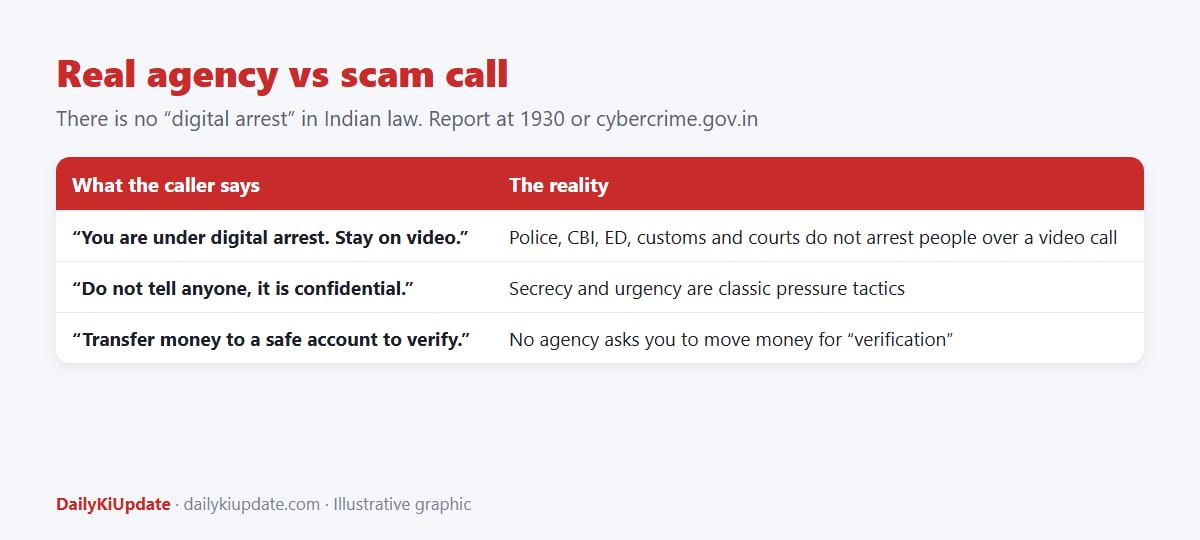
| What the caller says | The reality |
|---|---|
| "You are under digital arrest. Stay on video." | No agency arrests people over a video call |
| "Do not tell your family. This is confidential." | Secrecy and urgency are pressure tactics |
| "Transfer money to a safe account to verify it." | No investigating agency asks you to move funds for verification |
| "Pay a fine or bail now to avoid arrest." | Courts do not collect bail or fines over a phone call or UPI QR code |
| "Install this app so we can monitor your phone." | Remote access apps give scammers control of your banking |
| Official-looking logos and uniforms | Easy to fake. A video background proves nothing |
Why intelligent people fall for it
The scam is built to make you panic and then isolate you. It removes the one thing that saves most people: a calm conversation with someone they trust. Scammers also tend to have some real information about you, such as your name or number, often from data leaks, which makes the claim feel credible. Falling for it is not a measure of intelligence.
What to do in the first hour if money has gone
- Call 1930 (the national cybercrime helpline) immediately. Speed matters because the system can alert banks to freeze the receiving accounts while the money may still be there.
- Report online at cybercrime.gov.in with the transaction IDs, account numbers, phone numbers, and screenshots of the chats and calls.
- Call your bank on the number printed on your card or passbook and ask them to flag the transaction and block the card or net banking if needed.
- Keep the evidence. Do not delete chats, call logs or messages. Note the number, the time and the name the caller used.
- Remove any app they asked you to install, then change banking passwords and UPI PINs from a different device if you suspect remote access.
- File a police complaint at your local cyber cell or police station with the acknowledgement from the portal.
Recovery is not guaranteed, but reporting quickly gives you the best chance. Check also whether your own identity has been misused, using our guide on how to check the SIM cards in your name.
How to protect your family, especially older relatives
- Agree on one household rule: no one is ever "arrested" on a call, so hang up and ring a family member.
- Show them the table above, or print it and stick it near the phone.
- Keep UPI limits low on older relatives' accounts and set transaction alerts to your phone as well.
- Do not click links in messages about "pending parcel", "KYC expiry" or "SIM blocking".
Frequently asked questions
Is digital arrest real?
No. It is a scam. There is no legal concept of digital arrest in India.
What is the cybercrime helpline number?
1930. You can also report at cybercrime.gov.in.
Can the CBI or police arrest me on a video call?
No. Arrest requires lawful procedure and physical presence. Genuine agencies send written notices through proper channels.
I already paid. Can I get my money back?
Sometimes, especially if you report within the first hours. Call 1930 immediately and file a complaint. Recovery depends on whether funds are still in the receiving accounts.
How do I block scam numbers?
Report them through the Chakshu facility on the Sanchar Saathi portal and block them on your phone and WhatsApp.
Sources to verify
- National Cyber Crime Reporting Portal, for reporting and the 1930 helpline.
- Indian Cyber Crime Coordination Centre (I4C), MHA for advisories.
- Sanchar Saathi, DoT for reporting suspicious communication.