The Union Budget for 2026-27 did not change the income tax slabs. For FY 2026-27 (assessment year 2027-28), individuals still choose between the new tax regime, which is the default, and the old regime with its deductions. The new regime is tax-free up to ₹4 lakh, and with the Section 87A rebate there is no tax if taxable income is up to ₹12 lakh.
The slabs are the easy part. What most people need is an answer to a practical question: how much tax will I actually pay, and which regime is better? Below are the slabs, then worked examples with real arithmetic. Check the Income Tax Department for the final rules, because Finance Act amendments and notified changes can apply.
New tax regime slabs (default)
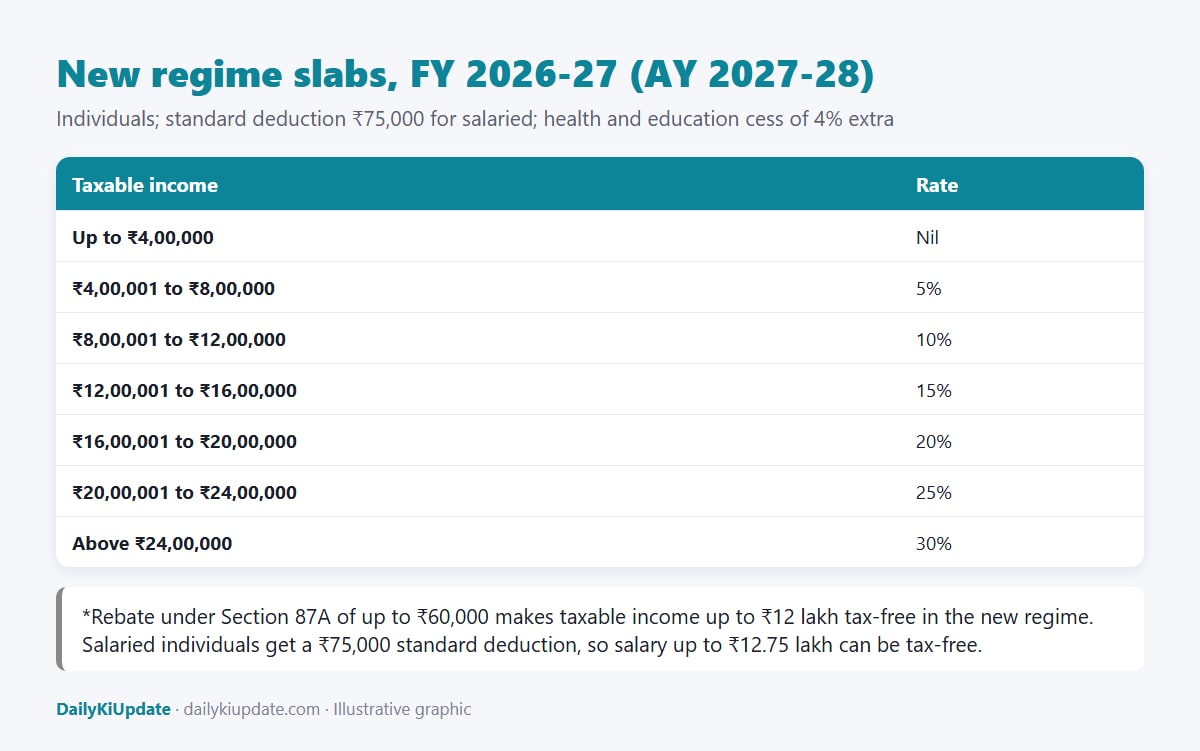
| Taxable income | Tax rate |
|---|---|
| Up to ₹4,00,000 | Nil |
| ₹4,00,001 to ₹8,00,000 | 5% |
| ₹8,00,001 to ₹12,00,000 | 10% |
| ₹12,00,001 to ₹16,00,000 | 15% |
| ₹16,00,001 to ₹20,00,000 | 20% |
| ₹20,00,001 to ₹24,00,000 | 25% |
| Above ₹24,00,000 | 30% |
Salaried individuals and pensioners get a standard deduction of ₹75,000 in the new regime. Under Section 87A, a rebate of up to ₹60,000 means that if your taxable income is up to ₹12 lakh, your tax after rebate is zero. Add the standard deduction, and a salaried person with income up to ₹12.75 lakh can be fully exempt from tax. Tax is then increased by 4% health and education cess.
Old tax regime slabs (for individuals below 60)
| Taxable income | Tax rate |
|---|---|
| Up to ₹2,50,000 | Nil |
| ₹2,50,001 to ₹5,00,000 | 5% |
| ₹5,00,001 to ₹10,00,000 | 20% |
| Above ₹10,00,000 | 30% |
The old regime gives a standard deduction of ₹50,000 for salaried people, and lets you claim deductions like Section 80C (up to ₹1.5 lakh), 80D (health insurance), home loan interest and HRA. The 87A rebate in the old regime is available only if taxable income is up to ₹5 lakh. Senior citizens have higher exemption limits. Check the department's slab table for age-specific slabs.
Worked example 1: salary of ₹15 lakh, new regime
- Gross salary: ₹15,00,000
- Less standard deduction: ₹75,000
- Taxable income: ₹14,25,000
- ₹0 to ₹4L: nil
- ₹4L to ₹8L: 5% of ₹4,00,000 = ₹20,000
- ₹8L to ₹12L: 10% of ₹4,00,000 = ₹40,000
- ₹12L to ₹14.25L: 15% of ₹2,25,000 = ₹33,750
- Tax before cess: ₹93,750 (no rebate as income exceeds ₹12 lakh)
- Cess at 4%: ₹3,750
- Total tax: ₹97,500
Worked example 2: salary of ₹10 lakh
New regime: taxable income ₹9,25,000 after the standard deduction. Tax = ₹20,000 (on ₹4L to ₹8L) + ₹12,500 (10% of ₹1,25,000) = ₹32,500. Because taxable income is below ₹12 lakh, the 87A rebate wipes it out. Tax payable: ₹0.
Old regime, with no deductions beyond the standard deduction: taxable income ₹9,50,000. Tax = ₹12,500 (5% on ₹2.5L to ₹5L) + ₹90,000 (20% of ₹4,50,000) = ₹1,02,500. Cess ₹4,100. Total: ₹1,06,600.
To bring the old regime down to zero for this salary you would need roughly ₹4.5 lakh or more of deductions, which is a lot for most people.
Which regime should you choose?
| If you... | Leaning |
|---|---|
| Have few deductions (no home loan, little 80C or HRA) | New regime |
| Earn up to about ₹12.75 lakh as a salaried person | New regime, as tax is nil |
| Pay a big home loan and rent HRA, and invest in 80C, NPS and health insurance | Compare. The old regime may win at higher incomes |
| Are close to ₹12 lakh of taxable income | Check marginal relief: tax above ₹12 lakh is capped at the amount by which income exceeds ₹12 lakh |
The simple test is to compute your tax both ways. Total your likely deductions (80C, 80D, HRA, home loan interest, NPS employer contribution) and compare. Many online calculators on the official portal and bank websites do this in minutes.
Common mistakes
- Forgetting the 4% cess when estimating tax.
- Assuming ₹12 lakh of salary is tax-free. It is ₹12 lakh of taxable income, which is why the standard deduction matters.
- Choosing the old regime out of habit and then not claiming enough deductions.
- Forgetting that business income and capital gains may follow different rules. Special-rate income such as certain capital gains does not get the 87A rebate.
- Missing the return deadline. See our guide on belated and revised returns.
Frequently asked questions
Is income up to ₹12 lakh tax-free in 2026-27?
In the new regime, taxable income up to ₹12 lakh gets a full rebate under Section 87A, so there is no tax after rebate. Salaried taxpayers get a ₹75,000 standard deduction on top.
Which regime is the default?
The new tax regime is the default, but you can opt for the old regime if it suits you.
What is the standard deduction in 2026-27?
₹75,000 in the new regime and ₹50,000 in the old regime, for salaried individuals and pensioners.
Has the Budget changed the slabs?
The Union Budget 2026-27 did not change the slabs.
Can I switch regimes every year?
Salaried individuals can generally choose each year. Those with business income have restrictions on switching back. Check with a tax professional.
Sources to verify
This is general information, not tax advice. Examples use simplified assumptions.