Almost every interview in India, whether for a campus placement, a first job or a senior role, begins with the same words: "Tell me about yourself." Many candidates waste it by reciting their resume from school onwards or by saying their name, hobbies and "I am hard-working." You can prepare this answer in advance, and a good one sets the tone for the entire interview.
Here is a simple, honest structure that works for freshers and experienced professionals alike.
What the interviewer is really asking
This is not a request for your life story. The interviewer wants to know, quickly: Who are you professionally? Are you relevant to this role? Can you communicate clearly? That is why the answer should be short, structured and tailored to the job.
The formula: present, past, future
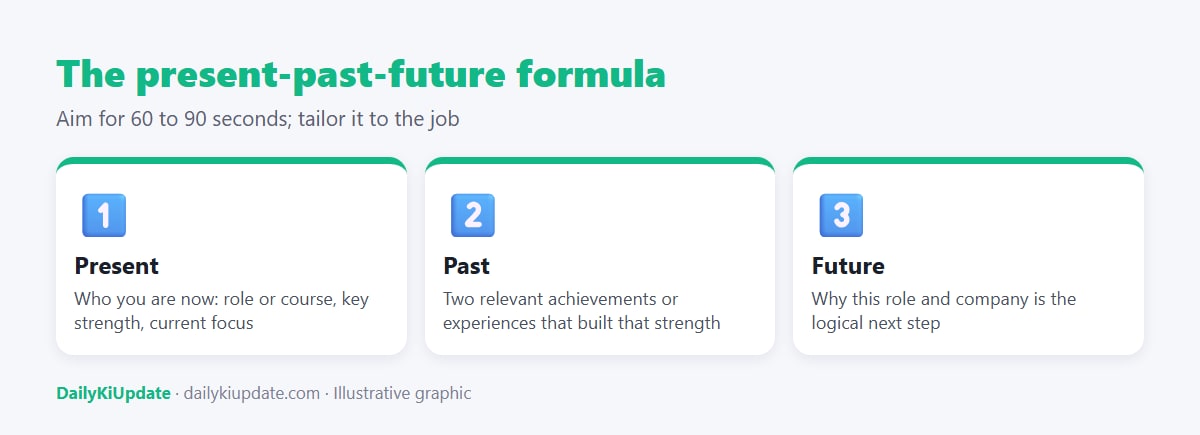
- Present (20 to 25 seconds): who you are now. Your current role or degree, what you do and one strength.
- Past (25 to 30 seconds): two or three relevant experiences or achievements, preferably with a number or concrete result.
- Future (15 to 20 seconds): why this role and this company is a natural next step for you.
Sample answer 1: a fresher
I am Priya, and I recently completed my B.Com from a Pune college. I enjoy working with numbers, and in my final year I led a team of four in a college project on small-business budgeting, where we built a simple Excel template that three local shopkeepers started using. Before that, I interned at a chartered accountant's office for two months, where I helped with GST filings and learned how to reconcile invoices. I am looking for a role in accounts, where I can build on that experience, and your company's focus on small and mid-sized clients is what drew me to this position.
(An illustrative sample. Replace every detail with your own true experience.)
Sample answer 2: an experienced professional
I am a customer support team lead with six years of experience in the e-commerce sector. Currently, I manage a team of 12 agents and handle escalations. Over the last two years, I redesigned our escalation checklist, which brought the average resolution time down from 48 to 30 hours, and I trained four new team leads. Earlier, I started as a support executive and moved up to a senior role in two years. I now want to move into a customer operations role with wider responsibility, which is why I am excited about this opening.
(An illustrative sample. Numbers are made up. Use only real figures you can discuss.)
Do and don't
| Do | Don't |
|---|---|
| Keep it to 60 to 90 seconds | Read your whole resume aloud |
| Tailor it to the job description | Give the same speech for every job |
| Use one or two real results with numbers | Use only vague adjectives like "hard-working" |
| Sound conversational and confident | Memorise it word for word so it sounds robotic |
| End with why you want this role | Stop abruptly or say "that's all" |
| Stay professional | Share family problems, salary demands or complaints about past employers |
Common mistakes
- Starting too far back. No one needs to hear about your Class 10 results unless you are a fresher with nothing else, and even then, keep it brief.
- Mentioning hobbies for too long. One short line is fine if it is relevant.
- Being negative about your past job or manager. Keep the story forward-looking.
- Exaggerating. Interviewers often ask follow-up questions on exactly what you claim. Only say what you can explain.
- Not practising aloud. Practise in front of a mirror or record yourself on your phone, and listen for filler words.
How to build your own answer in 15 minutes
- Read the job description and highlight the top three skills they want.
- Write one sentence for each part: present, past and future, using those skills.
- Add a number or concrete result to the "past" part, such as a project outcome, a percentage, or the size of a team.
- Trim it until you can say it comfortably in about a minute.
- Practise three times, and then stop memorising. Know the points rather than the exact words.
Prepare the rest of your interview
- Build a strong resume first: see our guide on writing a standout resume.
- Back up your claims with skills. Our guide to free online courses from SWAYAM and NPTEL shows where to learn them.
- Prepare for likely next questions: your strengths and weaknesses, why you are leaving your current role, and where you see yourself in a few years.
Frequently asked questions
How long should the answer be?
About 60 to 90 seconds.
Should a fresher mention hobbies?
Briefly, and only if relevant. A sentence about a sport, a community role or a project can show teamwork or discipline.
Should I mention my family background?
It is not necessary. If it is natural and brief, it is fine, but the focus should stay on your skills and goals.
What if I have a career gap?
Be honest, explain briefly and positively what you did during the gap (learning, caring for family, health), and move to what you can offer now.
Can I prepare the answer in Hindi?
Prepare it in the language you expect the interview to be conducted in. If it is mixed, practise in both.