You worked hard to get the offer. The first three months are where you turn that offer into a good reputation. Your manager and colleagues form first impressions quickly, and those impressions can last for years, as well as shape your probation review. A simple, structured plan keeps you from drifting or trying too hard.
This 30-60-90 day plan works across roles and sectors. Adjust it to your job and use your manager's guidance, which always comes first.

Before day one
- Re-read the job description and your offer letter. Note your probation period and notice period.
- Confirm the joining date, time, location and documents to bring (ID proofs, education certificates, relieving letter from your last employer, photographs, bank details).
- If you have the chance, learn about the company's products and recent news.
- If you have just left a job, see our resignation and exit checklist to make sure nothing was left behind.
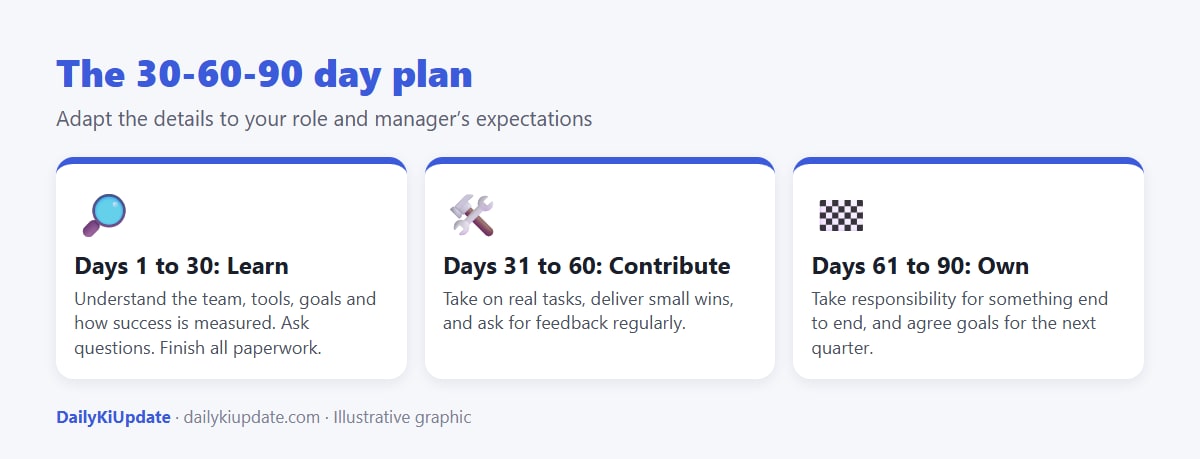
Days 1 to 30: Learn
Goal: understand the job, the people and how the work is done.
- Clarify expectations. In your first week, ask your manager: "What does success look like in 30, 60 and 90 days? What are the top three priorities? How would you like me to share updates?"
- Meet people. Introduce yourself to your team, to the people you work with across functions and to HR. Ask what they do and how you can help.
- Learn the systems. Set up your email, tools, access and documentation. Read the existing documents, reports, and past work.
- Listen more than you talk. Do not announce what is wrong with the way things are done. Understand why they are done that way first.
- Take notes of names, processes and questions. People forgive questions in the first month and are less forgiving in the fourth.
- Complete the paperwork: sign your appointment letter, submit documents for background verification, give your UAN for PF, and set up your salary account and insurance nominations.
Days 31 to 60: Contribute
Goal: deliver visible, reliable results on real work.
- Take real tasks and finish them on time. Reliability counts more than brilliance at this stage.
- Look for a quick win: a small problem you can solve, such as automating a report or fixing a recurring issue. Check with your manager before you act.
- Ask for feedback regularly, for example: "What is one thing I could do better?" Then act on it.
- Communicate proactively. Share short weekly updates about what you did, what is blocked and what is next.
- Build relationships beyond your immediate team. Have a coffee or a call with someone from another function.
Days 61 to 90: Own
Goal: take responsibility for something and plan the next quarter.
- Own a task or a small project from start to finish, and show the result with numbers where you can.
- Suggest an improvement based on what you now understand, and back it with facts.
- Review progress with your manager, ideally before the formal probation review. Ask: "Am I on track? What should I focus on next?"
- Set goals for the next quarter and a development area, such as a skill or course. See our free courses guide.
- Update your own record of achievements, which helps in appraisals and your resume.
Probation: what you need to know
- Probation is typically three to six months. Read your letter for the confirmation process and notice period during probation, which is often shorter.
- Ask when and how the review will happen, and what is assessed.
- Do not wait for the review to learn how you are doing. Ask for feedback early.
- Get your confirmation letter in writing.
Money and paperwork checklist
| Item | Why it matters |
|---|---|
| Appointment letter | Defines your terms: salary, notice period, probation and bond clauses |
| UAN and PF transfer | Link your existing UAN so that your PF history continues |
| Form 12B | Tells the new employer about income from your previous job in the same year, so that TDS is correct |
| Salary structure | Know your fixed, variable and in-hand figures. See our CTC guide |
| Health insurance and nominations | Add family members within the enrolment window, which can be short |
Common mistakes new joiners make
- Trying to prove yourself by criticising existing processes in week one.
- Not asking questions because you fear looking uninformed.
- Working in isolation and sharing no updates.
- Over-promising on deadlines.
- Ignoring office culture, such as meeting etiquette and working hours.
- Gossiping or taking sides in office politics.
- Skipping the paperwork, which can later delay salary or PF.
Frequently asked questions
What is a 30-60-90 day plan?
A simple framework that divides your first three months into learning, contributing and owning phases.
How long is probation in India?
It is commonly three to six months, depending on your company and contract.
Can I be fired during probation?
Probationers usually have a shorter notice period and fewer protections than confirmed employees, subject to your contract and applicable law.
Should I ask for feedback so early?
Yes. It shows maturity, and it helps you correct your course while there is time.
What if the job is not what I expected?
Talk to your manager first. If the gap is large, consider the options calmly, and do not resign in the first week without a plan.