
Everyone has heard that a Systematic Investment Plan (SIP) can make you a "crorepati". Whether that is true depends on two numbers that are rarely explained honestly: how much you invest every month, and for how long. This article gives you the actual monthly amounts for different time frames and explains what the numbers assume, and what they leave out.
Important: mutual fund returns are not guaranteed and can be negative in some years. The returns below (10% and 12% a year) are assumptions for illustration, not forecasts or promises.

Quick answer: monthly SIP needed for ₹1 crore
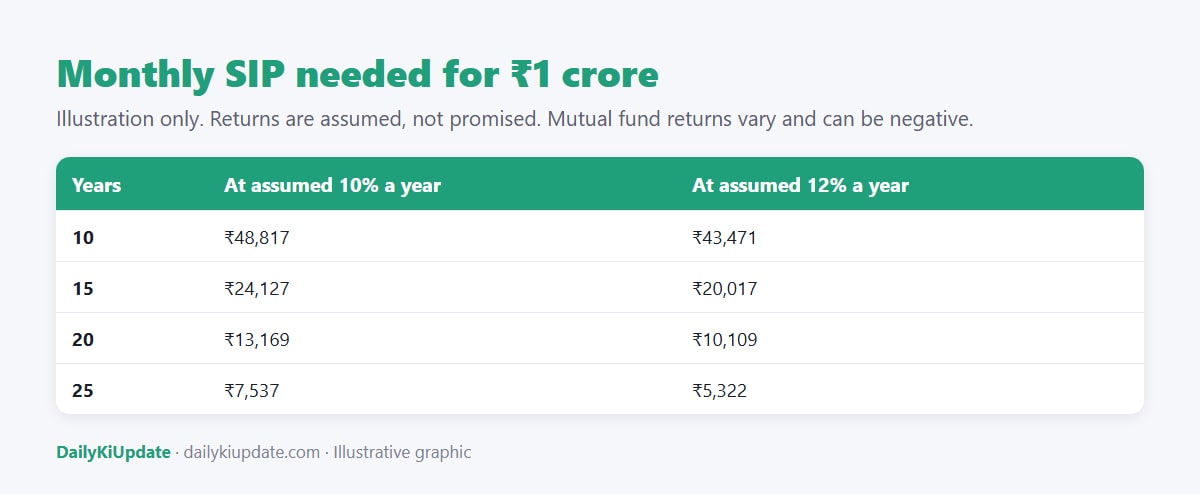
| Investment period | Assumed 10% a year | Assumed 12% a year |
|---|---|---|
| 10 years | ₹48,817 | ₹43,471 |
| 15 years | ₹24,127 | ₹20,017 |
| 20 years | ₹13,169 | ₹10,109 |
| 25 years | ₹7,537 | ₹5,322 |
Look at what time does. Doubling the period from 10 to 20 years cuts the monthly amount at 12% from about ₹43,500 to about ₹10,100, roughly a quarter. This is the effect of compounding, where the returns themselves earn returns.
How the numbers are calculated
The future value of a monthly SIP, assuming payments at the end of each month, is:
FV = P × [((1 + r)n − 1) ÷ r]
where P is the monthly amount, r is the monthly rate (annual rate ÷ 12) and n is the number of months. For example, ₹10,000 a month for 20 years (240 months) at 12% a year (1% a month) gives about ₹98.9 lakh. In the same way, ₹10,000 a month for 25 years at 12% gives about ₹1.88 crore, and at 10% about ₹1.33 crore.
What these numbers leave out
- Inflation. ₹1 crore in 20 years will buy much less than ₹1 crore today. At 6% inflation, ₹1 crore after 20 years has the buying power of about ₹31 lakh in today's money. If you need what ₹1 crore buys today, you will need a bigger target.
- Taxes. Gains on equity mutual funds are taxed on redemption, according to the capital gains rules in force at the time. This reduces what you finally get.
- Fund costs. Expense ratios reduce returns slightly every year. Direct plans cost less than regular plans.
- Return variability. Markets do not give 12% every year. A SIP might lose value for a couple of years, and then recover. The averages hide the ride.
- Step-up. If your income rises, you can increase your SIP every year. A 10% annual increase can shorten the time to the goal dramatically.
How to start without getting it wrong
- Build an emergency fund first. A SIP should not have to be broken when a medical bill arrives. See our guide on how much emergency fund you need.
- Complete your KYC and choose a registered mutual fund or platform. Check that the fund house is registered with SEBI.
- Pick funds that match your time frame. Equity funds suit goals of 7 years and longer. Short-term goals belong in safer products.
- Start with an amount you can sustain, even if it is only ₹1,000 or ₹2,000, and raise it with your income.
- Automate the SIP date right after salary credit.
- Review once a year, not every day. Frequent switching and stopping are the most common reasons SIPs underperform.
A realistic example
Suppose a 28-year-old can invest ₹10,000 a month. At an assumed 12%, that grows to about ₹99 lakh by age 48, close to ₹1 crore, and to about ₹3.5 crore by age 58 if continued for 30 years (assumed return, before tax). If the same person waits until 38 to start, the same ₹10,000 a month for 20 years is worth about ₹99 lakh at 58. Ten years of delay costs about ₹2.5 crore in this illustration.
Frequently asked questions
How much SIP for 1 crore in 10 years?
About ₹43,500 a month at an assumed 12% return, or ₹48,800 at 10%. Returns are not guaranteed.
Is ₹5,000 a month SIP enough?
At an assumed 12%, ₹5,000 a month grows to about ₹94 lakh in 25 years. It is a good start, and increasing it every year makes it more powerful.
Is 12% a realistic SIP return?
It is an assumption often used for equity funds over long periods, but actual returns can be lower or higher, and can be negative in the short term.
Can I lose money in a SIP?
Yes. Mutual funds carry market risk. Long holding periods reduce, but do not eliminate, the risk.
SIP or lump sum?
If you have a lump sum, you can invest it in stages. If you invest from your monthly income, SIP is the natural fit.
Sources to verify
- SEBI: investor education and registered intermediaries
- AMFI: mutual fund investor information and fund data
This is not investment advice. Mutual fund investments are subject to market risks; read all scheme-related documents carefully.