For central government employees, retirement income used to depend on one question: are you under the Old Pension Scheme or the National Pension System? Since 1 April 2025 there is a third option, the Unified Pension Scheme (UPS). It keeps the NPS framework but adds an assured payout.
This guide explains the difference in plain language, with worked examples. All scheme features below are taken from the PFRDA's UPS page. The numbers in the examples are made up for illustration, so replace them with your own.
Quick answer
- NPS: your pension depends on how much your corpus grows and the annuity you buy. There is no guaranteed amount.
- UPS: an assured payout of 50% of the average basic pay of the last 12 months for those with at least 25 years of qualifying service, a ₹10,000 a month minimum after 10 years, and a 60% family payout to the spouse.
- UPS applies from 1 April 2025 to eligible central government employees. Whether state governments adopt it is a state-level decision.
NPS vs UPS at a glance
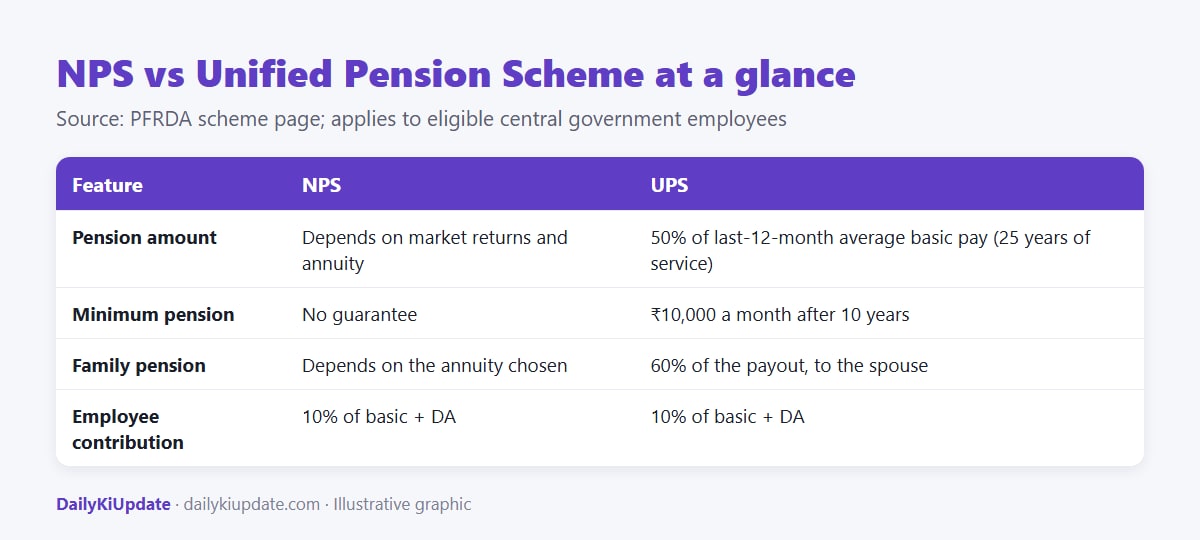
| Feature | NPS | UPS |
|---|---|---|
| Pension amount | Not assured; depends on corpus and annuity rates | Assured: 50% of last 12 months' average basic pay after 25 years of service |
| Shorter service | No concept of assured payout | Proportionate payout for service between 10 and 25 years |
| Minimum pension | None | ₹10,000 a month after 10 years of service |
| Family pension | Depends on annuity option chosen | 60% of the payout drawn just before death, to the legally wedded spouse |
| Employee contribution | 10% of basic pay + DA | 10% of basic pay + DA |
| Government contribution | 14% of basic pay + DA | 10% of basic pay + DA, plus a further contribution to a pool corpus (about 8.5% at launch) |
| Inflation protection | Not built in | Dearness relief applies to the payout |
| Lump sum at retirement | Up to 60% of corpus can be withdrawn | A lump sum linked to service, plus gratuity rules |
Worked examples (hypothetical numbers)
Example 1: 25 years of service
Suppose the average basic pay over your last 12 months is ₹80,000. Under UPS, the assured payout is 50% of that, which is ₹40,000 a month, before dearness relief.
Example 2: 20 years of service
For service between 10 and 25 years the payout is proportionate. With 20 of the required 25 years, it works out to 20/25 of 50%, which is 40% of ₹80,000, or ₹32,000 a month.
Example 3: 12 years of service
Proportionate calculation gives 12/25 of 50%, which is 24%. On ₹80,000 that would be ₹19,200. The ₹10,000 minimum matters only when the proportionate figure falls below it, for example with a low basic pay.
Example 4: lump sum on retirement
UPS provides a lump sum of one-tenth of the last drawn monthly pay (basic + DA) for every completed six months of service. For 25 years, that is 50 half-years. If your last basic + DA is ₹1,20,000, the lump sum is ₹1,20,000 ÷ 10 × 50 = ₹6,00,000. This is in addition to gratuity, according to the scheme description.
How the money behind each scheme works
Under NPS, the employee and government contributions go into an individual account, invested in market-linked funds. At retirement, you can withdraw part of the corpus and must use the rest to buy an annuity, and your income depends on how the investments performed.
Under UPS, individual contributions also go into an individual corpus, but a pool corpus is funded by the government's additional contribution to support the assured payout. If the individual corpus is not enough to pay the assured amount, the pool is meant to make up the difference. The final withdrawal from the individual corpus is limited, and a withdrawal reduces the assured payout proportionately. Read the PFRDA rules before you plan a large withdrawal.
Can I switch?
According to the PFRDA page, NPS-covered employees were given a window to opt for UPS, which was originally set to close on 30 November 2025 for existing employees and retirees, with new joiners having 30 days from joining. Once you choose UPS, you have a one-time, one-way option to move back to NPS. If you made no choice, you continue in NPS by default. Deadlines have been extended in some past cases, so check with your Drawing and Disbursing Officer or your department to see where you stand.
Who might prefer which?
- UPS may suit you if you value a predictable pension, have a long expected service of 25 years or more, and want a defined family payout.
- NPS may suit you if you are comfortable with market risk, expect strong returns on your corpus, and want flexibility in investment choice and a larger lump sum withdrawal.
- Short service: if you may leave government service early, compare the proportionate UPS payout with the NPS corpus you would likely build.
There is no universal winner. A good test is to estimate your likely NPS corpus using a conservative return assumption, convert it into a monthly annuity at a conservative annuity rate, and compare that with the assured UPS payout for your service length.
Common mistakes
- Comparing UPS with the Old Pension Scheme. UPS is not a return to OPS: it is contributory and the payout depends on years of service.
- Ignoring the 25-year threshold. A shorter service means a proportionate, lower payout.
- Forgetting that a one-way switch has consequences. Check the rules before using it.
- Assuming the rules cover state employees. They do not automatically.
Frequently asked questions
What is the Unified Pension Scheme?
A pension option within the NPS architecture for eligible central government employees, effective 1 April 2025, with an assured payout, a minimum pension and a family payout.
How much pension will I get under UPS?
50% of the average basic pay of the last 12 months, if you have at least 25 years of qualifying service. Less service gives a proportionate amount, with a ₹10,000 minimum after 10 years.
Is UPS better than NPS?
It depends on your service length, risk appetite and investment returns. UPS gives certainty. NPS gives market-linked upside and more flexibility.
Is UPS available to private sector employees?
No. It is designed for eligible central government employees.
Can I go back from UPS to NPS?
Yes, there is a one-time, one-way option to move back to NPS.
Sources to verify
- PFRDA for the official Unified Pension Scheme page and FAQs.
- Department of Expenditure and your own department for notifications and option deadlines.
Related: 8th Pay Commission status and what it means for your salary.
This is general information, not financial advice. Examples use made-up numbers.