The 8th Central Pay Commission is still collecting views and data. No new pay matrix, fitment factor or DA merger has been announced. Any figure you see on social media that claims to show your "new salary" is a guess.
This article sets out what has actually been confirmed, what is still open, and how to calculate a rough range for yourself using clearly labelled assumptions. Status is as of 7 October 2026.
What has been confirmed
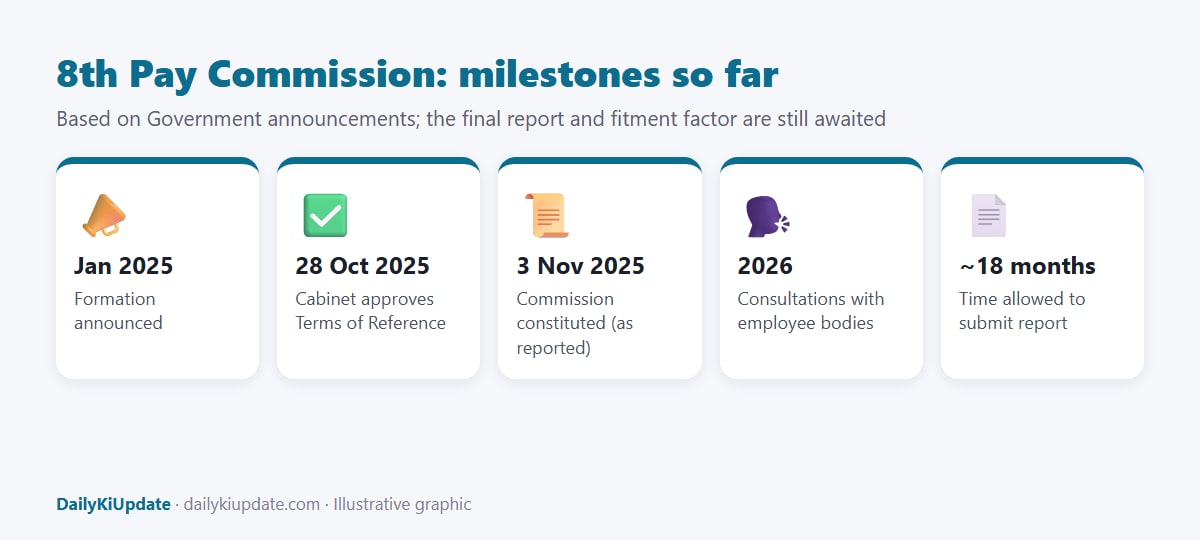
- The Government announced in January 2025 that the 8th Central Pay Commission would be set up.
- The Union Cabinet approved its Terms of Reference on 28 October 2025.
- The Commission is headed by Justice (Retd.) Ranjana Prakash Desai, with Prof. Pulak Ghosh and Pankaj Jain as members, as reported at the time of the announcement.
- It has been given about 18 months to submit its recommendations.
- The Commission was reported to have been formally constituted through a Gazette notification in early November 2025, and has since been holding consultations with employee organisations and other stakeholders.
- It covers roughly 50 lakh central government employees, including defence personnel, and a pensioner base reported at somewhere between 65 and 69 lakh depending on the source.
What the Commission has been asked to consider
According to published coverage of the Terms of Reference, the Commission must weigh the country's economic conditions and the need for fiscal prudence, the resources available for development and welfare spending, the unfunded cost of non-contributory pension schemes, the impact on state finances, and how pay and benefits compare in central public sector undertakings and the private sector. That list explains why timelines and numbers are hard to predict: the Commission is balancing employee expectations against the budget.
When could the new pay actually arrive?
History is the best guide, with the caveat that every Commission is different. The 7th Pay Commission was constituted in February 2014, submitted its report in November 2015 and its recommendations were applied from 1 January 2016, with the Cabinet approving the package in mid-2016 and arrears paid afterwards.
If the 8th Commission uses the full 18 months from its constitution, its report would be due around the middle of 2027. The Government then has to consider it and decide, which has usually taken several months. It has been widely reported that the revised pay could be applicable from 1 January 2026, which would mean arrears when it is eventually paid. This has not been confirmed as a final decision, so treat it as a likely rather than a guaranteed outcome.
What is still undecided
| Item | Status |
|---|---|
| Fitment factor | Not decided |
| New pay matrix and pay levels | Not decided |
| HRA and other allowance changes | Not decided |
| Pension and family pension formula | Not decided |
| Treatment of Dearness Allowance (DA) at the time of revision | Not decided |
| Effective date | Widely reported as 1 January 2026, not finally confirmed |
What is a fitment factor, in simple words?
The fitment factor is the multiplier used to convert your existing basic pay into your new basic pay. The 7th Pay Commission used a fitment factor of 2.57. Your new basic is found by multiplying the old basic by this number and then placing the result at the nearest figure in the new pay matrix. Allowances such as DA and HRA are then recalculated on the new basic.
An illustration: how a fitment factor changes basic pay
The factors below are hypothetical. They are not predictions, and none of them is an official figure. They only show how sensitive the result is to the multiplier.
| Current basic pay | If factor is 1.8 | If factor is 2.0 | If factor is 2.5 |
|---|---|---|---|
| ₹30,000 | ₹54,000 | ₹60,000 | ₹75,000 |
| ₹50,000 | ₹90,000 | ₹1,00,000 | ₹1,25,000 |
| ₹80,000 | ₹1,44,000 | ₹1,60,000 | ₹2,00,000 |
Two cautions. First, the pay matrix rounds your pay to a defined cell, so the real figure can differ slightly. Second, a bigger basic does not mean the same percentage rise in take-home pay, because deductions such as income tax and contributions will also change.
What this means for you
- Do not plan major purchases around an assumed new salary. There is no confirmed number yet.
- If you are a pensioner, the revision will also apply to pensions, but the formula is not decided.
- State government employees are not directly covered. States usually constitute their own commissions or follow the Centre later, and the timing differs for each state.
- Follow only official sources. Employee unions and departmental notices are useful, but only a Government order is final.
If you are also thinking about retirement, read our comparison of NPS vs the Unified Pension Scheme.
Frequently asked questions
Has the 8th Pay Commission been approved?
Yes, the Commission has been set up and its Terms of Reference were approved on 28 October 2025. Its recommendations have not been made yet.
When will the 8th Pay Commission be implemented?
No date has been officially fixed. The Commission has about 18 months to report, after which the Government must decide on its recommendations.
What is the fitment factor for the 8th Pay Commission?
It has not been decided. The 7th Pay Commission used 2.57.
Will I get arrears?
If the revised pay is made applicable from 1 January 2026 as widely reported, arrears from that date are likely when it is paid. This depends on the Government's final decision.
Does the 8th Pay Commission apply to state employees?
Not directly. State governments decide separately, though many follow the Centre's pattern.
Sources to verify
- Press Information Bureau for Cabinet decisions and Terms of Reference.
- Department of Expenditure for official notifications.
Illustrative figures are for explanation only and should not be treated as official or predicted numbers.