If you did not file your income tax return by 31 July 2026, you have not lost the chance. For the financial year 2025-26 (assessment year 2026-27), a belated return can be filed up to 31 December 2026. If you already filed and spotted a mistake, a revised return can also be filed until the same date.
The price of waiting is a late fee, interest on any unpaid tax and the loss of a few benefits. This guide explains each in rupees and gives a short checklist so you can file calmly.
Quick answer
- Belated return: file by 31 December 2026 (Section 139(4)).
- Revised return: file by 31 December 2026 (Section 139(5)), if you have already filed and need to correct it.
- Late fee (Section 234F): up to ₹5,000 if your total income is above ₹5 lakh, up to ₹1,000 if it is ₹5 lakh or less, and nil if your income is below the basic exemption limit.
- Interest (Section 234A): 1% per month or part of a month on unpaid tax from the due date until you pay.
- Always confirm on the official e-filing portal, in case the Government has announced any change.
Belated vs revised vs updated return
| Type | When you use it | Last date for AY 2026-27 |
|---|---|---|
| Original return | Filed on time | 31 July 2026 (non-audit individuals) |
| Belated return | You missed the due date | 31 December 2026 |
| Revised return | You filed but found an error or omission | 31 December 2026 |
| Updated return (ITR-U) | You missed both windows or need to add income | Within the time allowed under Section 139(8A), with extra tax |
For taxpayers whose accounts are audited, the regular due date is later (31 October for most such cases), so the belated and revised timeline works differently. If this applies to you, check with your auditor.
What does a late filing cost?
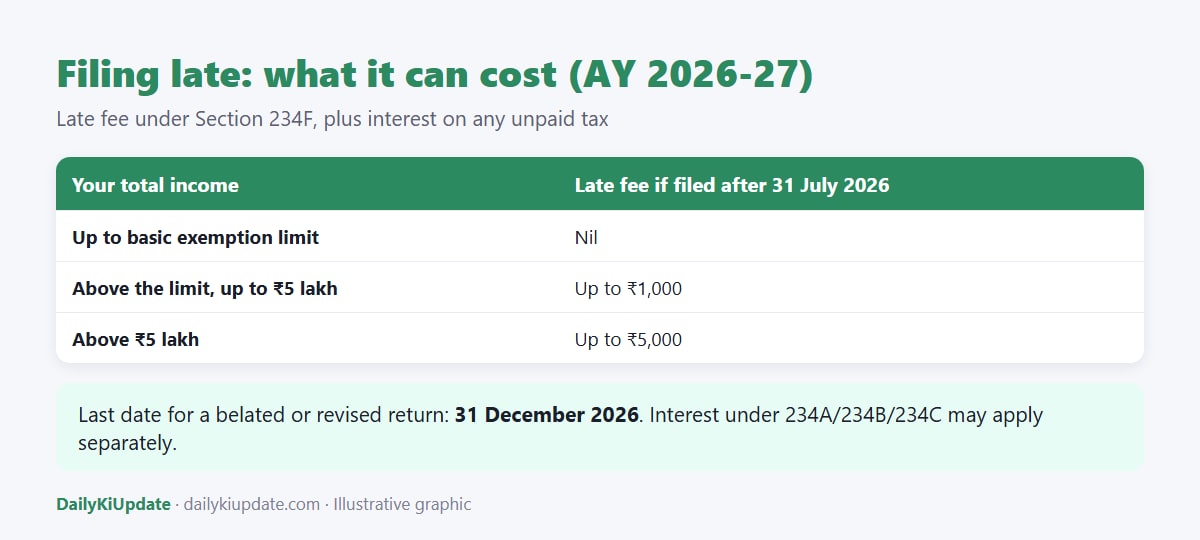
1. Late fee under Section 234F
The fee is charged automatically by the portal when you file after the due date. It is ₹1,000 if your total income is up to ₹5 lakh and ₹5,000 if it is above ₹5 lakh. If your income is below the basic exemption limit, no fee applies.
2. Interest under Section 234A
If you still owe tax after adjusting TDS and advance tax, interest is charged at 1% per month or part of a month. A worked example, using round numbers:
| Item | Amount |
|---|---|
| Tax still unpaid after TDS | ₹40,000 |
| You file and pay 3 months and 10 days after the due date, which counts as 4 months | |
| Interest at 1% a month | ₹40,000 × 1% × 4 = ₹1,600 |
| Late fee (income above ₹5 lakh) | ₹5,000 |
| Total extra cost | ₹6,600 |
If your tax was fully covered by TDS, you may owe no interest at all and the only cost is the late fee.
3. Other consequences
- Most losses, such as capital losses and business losses, cannot be carried forward if the return is filed late. A house property loss is an exception.
- If you are due a refund, you can still claim it in a belated return, but interest on the refund is generally calculated from the date you file, and the refund may take time.
- Some deductions and exemptions are tied to filing before the due date, so a belated return can reduce what you are able to claim.
Step-by-step: file a belated return
- Gather Form 16, Form 26AS and the Annual Information Statement (AIS) from the portal, along with bank interest certificates and investment proofs.
- Log in to the e-filing portal with your PAN and select the correct assessment year, 2026-27.
- Choose the right ITR form. Most salaried individuals with simple income use ITR-1 or ITR-2, depending on the income sources.
- Select the filing type "Belated return, Section 139(4)" where the portal asks for it.
- Check that income and TDS match your AIS, then calculate tax. The portal will add the Section 234F fee and any interest.
- Pay any balance tax through the e-pay tax facility, then submit.
- E-verify the return, with Aadhaar OTP or net banking, so that it is treated as complete. An unverified return is not treated as filed.
Step-by-step: file a revised return
- Log in and go to e-File, then Income Tax Returns, then File Income Tax Return.
- Choose the assessment year and the same ITR form you used the first time.
- Select "Revised return, Section 139(5)" and enter the acknowledgement number and date of the original return.
- Correct the figures, pay any extra tax and e-verify.
Common mistakes to avoid
- Filing without checking AIS. Mismatches between AIS and your return are a common trigger for notices.
- Not e-verifying. The return is not valid until it is verified.
- Waiting until the last week. The portal is slower in the final days.
- Leaving out bank interest. It is taxable, even from a savings account, subject to the deduction limit.
- Assuming no tax means no return. If your income crosses the exemption limit or you want to claim a refund, you should still file.
Frequently asked questions
What is the last date for belated ITR for AY 2026-27?
31 December 2026, or before the assessment is completed, whichever is earlier.
What is the penalty for filing ITR late?
A late fee of up to ₹5,000 under Section 234F (₹1,000 if income is up to ₹5 lakh), plus interest on any unpaid tax.
Can I still get a refund if I file late?
Yes. You can claim a refund through a belated return, though interest on the refund is calculated from the date of filing.
What if I miss 31 December 2026 too?
You may still be able to file an updated return (ITR-U) within the permitted time, by paying additional tax. Take advice from a tax professional.
Can I file a revised return more than once?
Yes, within the time limit. There is no fixed cap on the number of revisions, but each revision should fix a genuine error.
Sources to verify
- Income Tax Department e-filing portal for due dates, forms and the official FAQs.
- incometaxindia.gov.in for the Act, rules and circulars.
This is general information, not tax advice. Your situation may differ, especially if you have business income, capital gains or foreign assets.
Also read: 9 best budgeting apps for beginners to keep tax money aside through the year.