Most people compare health insurance policies by premium. That is the wrong way to start. Two policies with the same premium can pay out very different amounts, because the real differences sit in the small print: room-rent limits, waiting periods, co-payment and sub-limits. A policy that looks cheap can become expensive when you actually claim.
This checklist focuses on the things that most often change the result of a claim. It is general guidance. Always read the policy wording and the IRDAI-mandated customer information sheet before paying.
The 10-point checklist
1. Sum insured
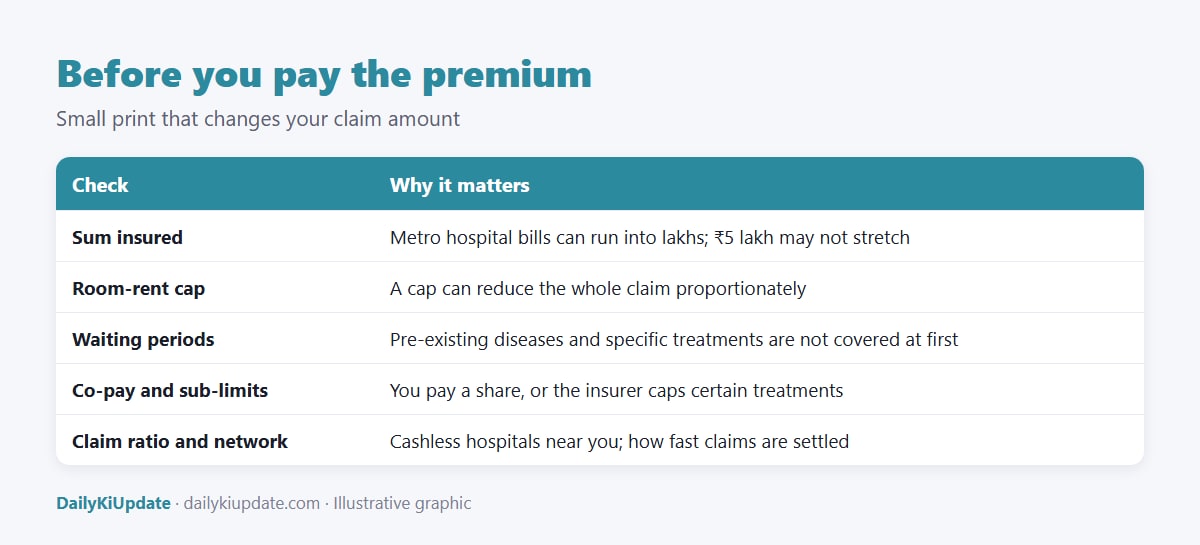
Hospital costs in metro cities can be high, and medical inflation is real. For a family in a metro, many advisers suggest a base cover of at least ₹10 lakh, topped up with a low-cost super top-up policy. Choose according to your city, age and family history rather than the cheapest option.
2. Room-rent limit
Some policies cap the room rent, for example at 1% of the sum insured per day. If you take a room costing more than the cap, many policies reduce other charges proportionately too. Example: a cap of ₹5,000 per day (1% of ₹5 lakh) and a room at ₹10,000 per day may cut your whole claim by half on room-linked items. Prefer policies with no room-rent limit, or with a limit that covers a single private room.
3. Waiting periods
- Initial waiting period: typically 30 days for non-accident illnesses.
- Pre-existing diseases (PED): under the IRDAI master circular for health insurance (2024), the maximum waiting period for pre-existing conditions was reduced to 3 years.
- Specific illnesses: cataract, hernia, joint replacement and similar treatments often carry 1 to 2 year waiting periods.
Tell the insurer about every existing condition honestly. After a moratorium period, which IRDAI has set at five continuous years, claims generally cannot be rejected for non-disclosure except in cases of proven fraud.
4. Co-payment
Co-pay means you pay a fixed percentage of every claim. A 20% co-pay on a ₹3,00,000 bill means ₹60,000 out of your pocket. It reduces the premium but increases your risk. Senior citizen plans often include a co-pay, so check it.
5. Sub-limits on treatments
Some policies cap the payout for specific procedures, such as cataract, knee replacement or certain illnesses. Check the list of sub-limits in the policy schedule.
6. Cashless network
Check whether the hospitals you would actually use, near your home and your parents' home, are on the insurer's cashless list. For cashless claims, IRDAI's circular asks insurers to decide on cashless requests within an hour and give final authorisation at discharge within three hours, but details depend on the insurer.
7. Restoration and no-claim bonus
Restoration re-instates your sum insured if it is used up during the year. A no-claim bonus increases your cover for each claim-free year. Both are valuable. Check how they work for the whole family on a floater.
8. Day-care and pre/post hospitalisation
Many treatments no longer need 24-hour admission. Check that modern day-care procedures are covered, and how many days before and after hospitalisation are included, for example 60 days before and 90 days after.
9. Exclusions and disease-wise limits
Read the permanent exclusions list. Check whether mental health care, maternity, AYUSH treatment, organ donor expenses and treatments for infertility are covered or excluded.
10. Claim settlement record and renewability
Look at the insurer's claim-settlement ratio and the incurred claim ratio published by IRDAI, and customer reviews on claim handling. Check that the policy is renewable for life and portable if you want to move to another insurer.
Individual vs family floater
- Floater: a single sum insured shared by the family. Premium is lower, but one big claim can use up cover for everyone.
- Individual policies: each member has their own cover. Better for older parents, who should usually have a separate policy so their higher premium does not push up the rest of the family's.
Tax and GST points
Premiums for health insurance can qualify for a deduction under Section 80D in the old tax regime, with higher limits for senior citizens. At the time of writing, GST on individual health insurance premiums was exempted from September 2025. Check the current rules before you buy. In the new tax regime, 80D is not available, which is one of the factors in our new vs old regime comparison.
Government cover is not a replacement
If you or your parents are eligible for a government scheme, read our guide to the Ayushman Bharat PM-JAY and Vay Vandana card. Many families use it alongside private cover.
Frequently asked questions
How much health insurance do I need?
It depends on your city, age and family history. Many advisers suggest a minimum of ₹10 lakh for a metro family, plus a super top-up.
What is the waiting period for pre-existing diseases?
Under the IRDAI rules, the maximum is 3 years. Many policies are shorter, so compare.
Is cashless always possible?
Only at network hospitals and for approved treatments. Otherwise you pay and claim a reimbursement.
Can I port my policy?
Yes. IRDAI rules allow portability, and your accrued waiting-period credit is carried over, subject to the new insurer's underwriting.
Should I rely on my employer's group cover?
It can end when you leave the job. Keep a personal policy as well.
Sources to verify
- IRDAI: regulations, circulars and policyholder protection
- IRDAI Bima Bharosa: complaints and claim grievances
General information, not insurance advice. Terms differ by insurer and product; read the policy wording.