A credit card is one of the cheapest forms of short-term credit in India if you pay the full bill every month. It is also one of the most expensive if you do not. Interest rates on unpaid balances are commonly in the range of 3% to 3.75% per month, which is about 36% to 45% a year, though every bank sets its own rate. This guide explains how the system works, with a rupee example so you can see the damage.
Key terms in plain language
- Billing cycle: the roughly 30-day period for which purchases are added to one statement.
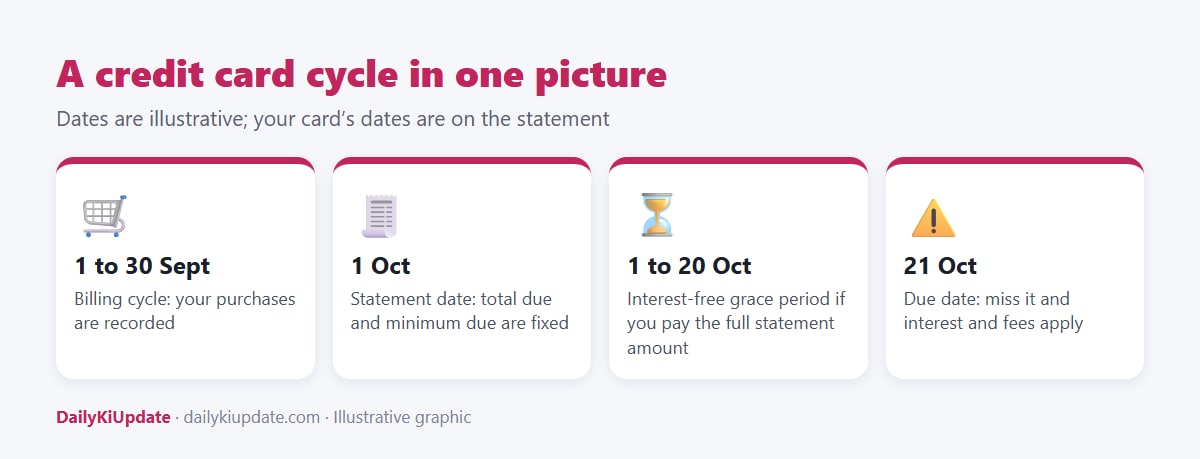
- Statement date: the day the bill is generated.
- Due date: the last date to pay. It is usually about 18 to 20 days after the statement date.
- Total amount due: everything you owe on the statement.
- Minimum amount due: a small part (often about 5% of the outstanding, plus any fees and EMIs) that stops you from being marked late.
- Interest-free (grace) period: the time between the purchase and the due date, which can be up to about 50 days, but only if you paid the previous statement in full.
What happens if you pay only the minimum due?
Paying the minimum avoids the late fee, but interest starts on the entire outstanding amount, and you lose the grace period on new purchases too. Interest is typically calculated daily from the date of each transaction until it is paid.
Example: ₹50,000 outstanding
Assume a monthly interest rate of 3.5%, a typical rate on many cards (check yours).
| Item | Calculation | Amount |
|---|---|---|
| Balance carried | ₹50,000 | |
| Interest for one month | ₹50,000 × 3.5% | ₹1,750 |
| GST on interest | 18% of ₹1,750 | ₹315 |
| Cost of carrying for one month | ₹2,065 | |
| Equivalent annual interest rate | 3.5% × 12 | About 42% a year |
That ₹2,065 a month is the price of not clearing ₹50,000. After six months of paying only the minimum, you could have paid over ₹12,000 in interest and GST and still owe most of the principal, depending on the minimum due and new spending.
Fees to watch for
- Late payment fee: charged if you miss the minimum due, often a slab based on the outstanding.
- Cash advance fee: withdrawing cash from an ATM usually costs a fee (often around 2.5% to 3%) and interest from day one, with no grace period.
- Over-limit fee and foreign currency mark-up on international spending.
- Annual fee, which may be waived if you spend a certain amount in the year.
- EMI conversion and processing fees on converting purchases to EMI.
How to avoid paying interest
- Pay the total amount due, not the minimum, by the due date every time. Set up auto-debit for the full amount.
- Use the card only for planned spending that you can pay from this month's income.
- Keep the due date visible. Set a calendar reminder three days before it.
- If you cannot pay in full, pay as much as possible. The interest falls with each rupee paid.
- Avoid cash withdrawals from your credit card.
If you are already in a debt trap
- List every card with the outstanding amount and interest rate.
- Pay the minimum on all of them, and put every extra rupee on the one with the highest rate.
- Consider a personal loan or balance transfer at a lower rate to clear card debt, but only if you stop spending on the card. Compare total cost, including processing fees.
- Talk to your bank before you miss payments. Banks can sometimes offer a structured plan.
- Avoid "debt settlement" companies that promise to cut your debt. A settlement can damage your CIBIL score for years.
Frequently asked questions
What is a good credit card interest rate in India?
There is no good rate on carried balances. Most are 3% to 3.75% a month. The only cost-free way to use a card is to pay in full.
Does paying the minimum due hurt my credit score?
Paying the minimum keeps the account from being marked as late, but high utilisation and ongoing balances can reduce your score.
What is the interest-free period?
The time between your purchase and the due date, up to about 50 days, available only if you pay the full previous bill.
Can I convert a big purchase into EMI?
Yes. It usually carries a lower rate than revolving interest, but a processing fee applies. Compare the total cost.
Is GST charged on credit card interest?
GST at 18% applies on interest and fees, as per current rules.
Sources to verify
- RBI: master directions on credit card and debit card issuance
- RBI Sachet and the Banking Ombudsman: complaints about banks
Rates and fees differ across banks and cards. Check your own card agreement. This is general information, not financial advice.