A CIBIL score is a three-digit number between 300 and 900 that summarises how you have handled credit so far. Banks and NBFCs use it, along with your income and other factors, to decide whether to approve a loan or credit card and at what interest rate. A higher score generally means easier approval and lower rates.
The good news is that a score is not fixed. It reflects your behaviour, so it can be repaired with consistent habits. Here is what matters and what does not.
What is a good CIBIL score?
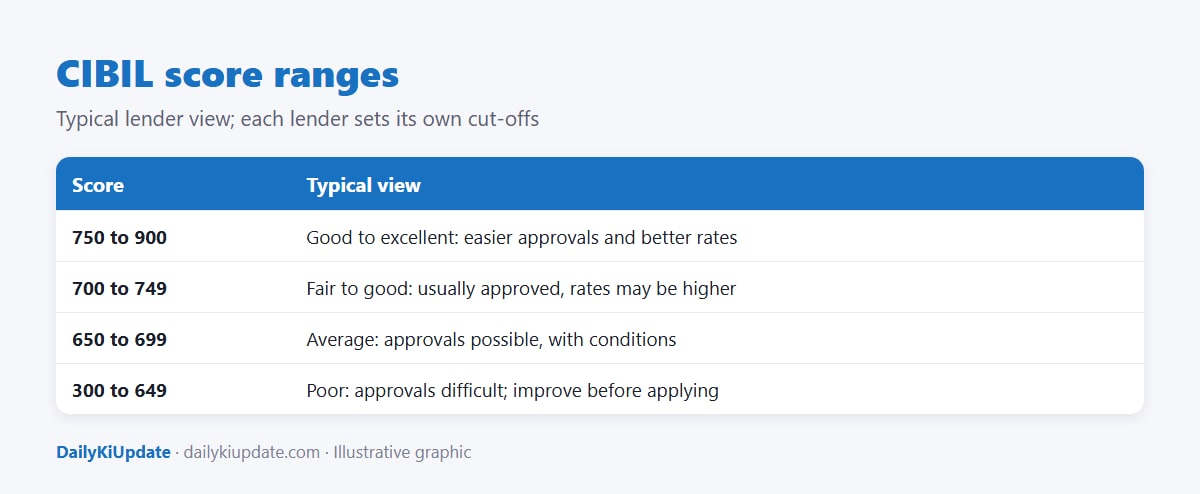
Lenders commonly treat 750 and above as good. Between 700 and 749 you will often still be approved, and below 650 it gets difficult. These are rules of thumb, not official bands, and every lender has its own policy. A score of 0 or -1 usually means you have no credit history yet, not a bad one.
What affects your score?
- Payment history: paying EMIs and card bills on time is the biggest factor. Even one 30-day delay can hurt.
- Credit utilisation: how much of your card limit you use. Staying under about 30% of the limit is the common guideline.
- Length of credit history: older accounts in good standing help. Do not close your oldest card without thinking.
- Credit mix: a healthy mix of secured loans (home, car) and unsecured credit (cards, personal loans) is viewed more favourably than unsecured credit alone.
- Recent enquiries: each loan or card application triggers a "hard enquiry". Several in a short time can lower your score.
- Defaults, settlements and write-offs: these stay on your report for years and weigh heavily. A "settled" status is viewed more negatively than "closed" after full payment.
How to check your score and report
Under RBI rules, each credit information company (CIBIL, Experian, Equifax, CRIF High Mark) must give you one free full credit report every calendar year. Request it from the company's official website. Some apps and banks also show scores for free, but those can be from a different bureau and the number may differ by a few points. Checking your own score is a "soft enquiry" and does not reduce it.
Read the report carefully: accounts you do not recognise, wrong repayment status or old closed loans shown as open are all worth a dispute.
How to fix mistakes in your report
- Raise a dispute on the credit bureau's portal with supporting documents.
- Also write to the lender (bank or NBFC) that reported the error.
- RBI rules require credit bureaus and lenders to resolve complaints within 30 days, and compensation of ₹100 per day of delay applies in qualifying cases. Keep proof of your complaint date.
8 practical ways to improve a low score
- Set auto-pay for at least the minimum due on every card and EMI. Pay the full statement amount when you can.
- Bring utilisation down. If your limit is ₹1,00,000, try to keep your statement balance under ₹30,000.
- Do not close old cards that have a clean history, unless the annual fee is a problem.
- Pause new applications for six months. Each hard enquiry lowers the score slightly.
- Clear overdue accounts and ask for them to be marked "closed", not "settled".
- Ask for a limit increase on a good card, which lowers your utilisation if you do not spend more.
- Add a small secured product if you have no history, such as a secured credit card against a fixed deposit.
- Be patient. A bad record may take 6 to 12 months of good behaviour to show a clear improvement.
Beware of "score repair" scams
Companies that promise to "remove negative entries" or raise your score by 100 points in a week are not telling the truth. Genuine errors can be corrected through the dispute process, but accurate records cannot be erased. Never pay upfront fees to such agencies, and do not share OTPs or card details with them. For other frauds, see our guide on the digital arrest scam.
Frequently asked questions
What is a good CIBIL score to get a home loan?
Lenders generally prefer 750 or above, although approvals at lower scores are possible with a higher interest rate or other conditions.
Does checking my own score reduce it?
No. A self-check is a soft enquiry and has no effect.
How long does it take to improve a CIBIL score?
A few months of on-time payments and low utilisation often show improvement, but serious defaults take longer.
Is a score of 650 bad?
It is considered average to low. You may still get a loan, but at a higher interest rate.
Does paying off a loan early help?
It reduces debt and is generally positive, but it can slightly shorten your credit history if it was your oldest account.
Sources to verify
- TransUnion CIBIL: official score and report
- RBI: credit information company rules and customer rights
General information, not financial advice. Scoring models are proprietary and change over time.