Every October and November, as the festival season arrives and the winter air becomes still, Indian cities, particularly in the north, begin to talk about the Air Quality Index. The number on your phone matters, but only if you know what it means and what to do about it.
This guide explains how the AQI works in India, what each category means, what the Graded Response Action Plan (GRAP) does in Delhi-NCR, and practical ways to cut your exposure. It is general health information, not medical advice.
What is the AQI?
The Air Quality Index turns the concentration of several pollutants into a single number from 0 to 500, so that the public can understand it easily. India's National Air Quality Index, run by the Central Pollution Control Board (CPCB), considers pollutants including PM2.5 and PM10 (fine particles), nitrogen dioxide, sulphur dioxide, carbon monoxide, ozone and ammonia. The overall AQI is determined by the pollutant that is worst at that moment, which in winter is usually PM2.5.
PM2.5 particles are smaller than 2.5 micrometres, thin enough to travel deep into the lungs and, according to health research, into the bloodstream.
AQI categories and what they mean
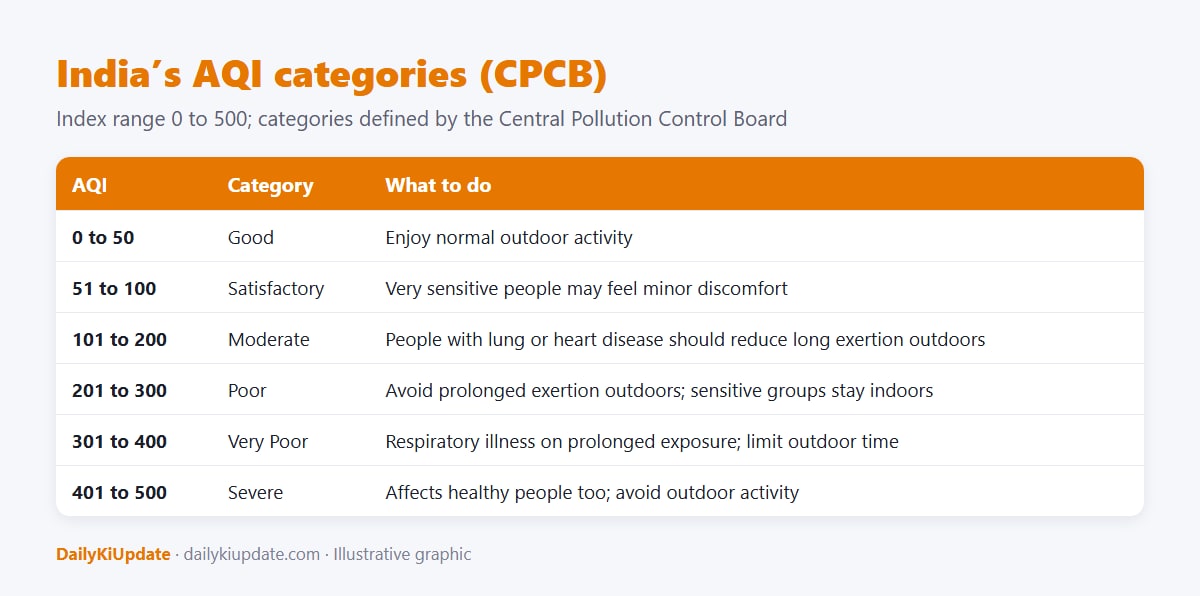
| AQI range | Category | Health implication (CPCB) |
|---|---|---|
| 0 to 50 | Good | Minimal impact |
| 51 to 100 | Satisfactory | Minor breathing discomfort to sensitive people |
| 101 to 200 | Moderate | Breathing discomfort to people with lung disease, asthma and heart disease |
| 201 to 300 | Poor | Breathing discomfort to most people on prolonged exposure |
| 301 to 400 | Very Poor | Respiratory illness on prolonged exposure |
| 401 to 500 | Severe | Affects healthy people and seriously impacts those with existing diseases |
Note that India's scale is different from the US AQI scale, so the same pollution level can give different numbers on different apps. Check which scale your app uses. The CPCB's SAMEER app and the official CPCB website show the Indian index.
What is GRAP?
The Graded Response Action Plan is a set of emergency measures for Delhi-NCR that come into force as air quality worsens. The Commission for Air Quality Management (CAQM) puts the stages into effect on the basis of the AQI. As commonly described:
| GRAP stage | Air quality level | Examples of measures |
|---|---|---|
| Stage 1 | Poor (AQI 201 to 300) | Stricter dust control at construction sites, curbs on open burning, enforcement against polluting vehicles |
| Stage 2 | Very Poor (AQI 301 to 400) | More enforcement, restrictions on diesel generators, more parking fees and public transport push |
| Stage 3 | Severe (AQI 401 to 450) | Restrictions on certain construction and demolition work and on some vehicles |
| Stage 4 | Severe+ (AQI above 450) | The strictest measures, such as limits on truck entry and further construction bans |
The measures within each stage are revised from time to time, so check the CAQM's latest order for the current list. GRAP is applied for the Delhi-NCR region only.
Who is most at risk?
- Children, whose lungs are still developing
- Older adults
- Pregnant women
- People with asthma, COPD, heart disease or diabetes
- Outdoor workers, such as drivers, traffic police, delivery workers and street vendors
Practical steps to protect yourself
- Check the AQI before you go out. Use the CPCB or a reliable local source, and plan outdoor exercise for cleaner hours. Pollution is often worst in the early morning and late evening in winter.
- Wear the right mask when the air is bad. An N95 or FFP2 respirator that fits tightly over the nose and mouth filters fine particles. A loose cloth or surgical mask does little against PM2.5.
- Keep windows closed on very poor days, and air your home when the outdoor air is relatively cleaner.
- Consider an air purifier with a HEPA filter, sized for the room, in bedrooms or the room where a child or elderly person spends the most time. Check that the clean air delivery rate (CADR) suits your room size.
- Avoid adding to indoor pollution. No smoking indoors, and limit incense, mosquito coils and dust. Mop rather than sweep dry.
- Reduce strenuous outdoor exercise when the AQI is Poor or worse. Choose indoor activity.
- Stay hydrated, and eat a balanced diet. This does not remove pollution from your lungs, but supports general health.
- Keep medicines handy if you have asthma or a heart condition, and follow your doctor's action plan.
Diwali and the air
Air quality typically drops around Diwali because of firecrackers, stubble burning in some regions and slow winds. Firecracker rules differ by city and are decided by authorities and courts, so check the current rules for your area. If you have children or elderly relatives, consider lamps and lights over crackers. See our Diwali 2026 guide for dates.
When to see a doctor
Seek medical help if you have breathlessness, chest tightness, wheezing, a persistent cough, or symptoms that do not improve indoors. Also contact a doctor if a child or an older person's breathing seems worse. For a fever with body pain at this time of year, also consider dengue.
Frequently asked questions
What AQI is safe?
0 to 50 is Good and 51 to 100 is Satisfactory. Above 200, even healthy people may notice effects with prolonged exposure.
Why is Delhi's AQI worse in winter?
Cold air and low winds trap pollution near the ground, and sources like vehicles, dust, burning and firecrackers add to it.
Does an N95 mask really help?
Yes, if it fits tightly. Check that there are no gaps at the sides and nose.
Is the AQI on my phone the same as CPCB's?
Not always. Apps may use the US scale or data from different stations. Use the CPCB for the official Indian index.
Do indoor plants clean the air?
Not enough to make a measurable difference in a typical home. A good purifier and ventilation work better.
Sources to verify
- CPCB: National Air Quality Index and live data
- Commission for Air Quality Management: GRAP orders
- WHO: air pollution and health
General information, not medical advice.