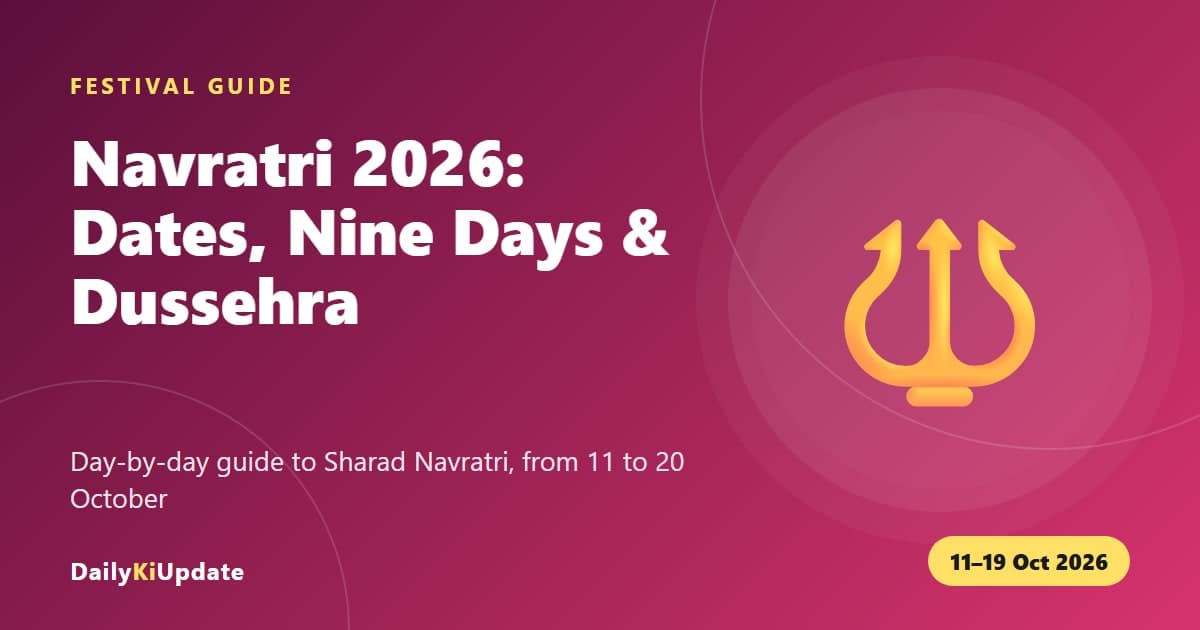
Sharad Navratri 2026 begins on Sunday, 11 October and ends on Monday, 19 October. Vijayadashami, better known as Dussehra, falls the next day, Tuesday, 20 October 2026.
This is the Navratri that most of India means when it says "Navratri" without a qualifier. It comes in the Hindu month of Ashwin, after the monsoon, and leads straight into Dussehra and then Diwali. Below is a plain day-wise guide, the usual fasting basics, and the points where families and regions do things differently.
Navratri 2026 key dates
| Event | Date |
|---|---|
| Navratri begins (Pratipada, Ghatasthapana) | Sunday, 11 October 2026 |
| Navratri ends (Navami) | Monday, 19 October 2026 |
| Dussehra (Vijayadashami) | Tuesday, 20 October 2026 |
| Diwali | Sunday, 8 November 2026 |
Tithis in the Hindu calendar do not line up neatly with civil days. A tithi can start or end at an odd hour, and occasionally one is skipped or repeated, which is why some local calendars show Ashtami and Navami on slightly different dates. Use the dates above as a national guide and follow your local Panchang for the day you plan to do kanya pujan or havan.
The nine days and the nine forms of Durga
Each day is dedicated to one form of the goddess, called the Navadurga. The order is the same in most traditions.
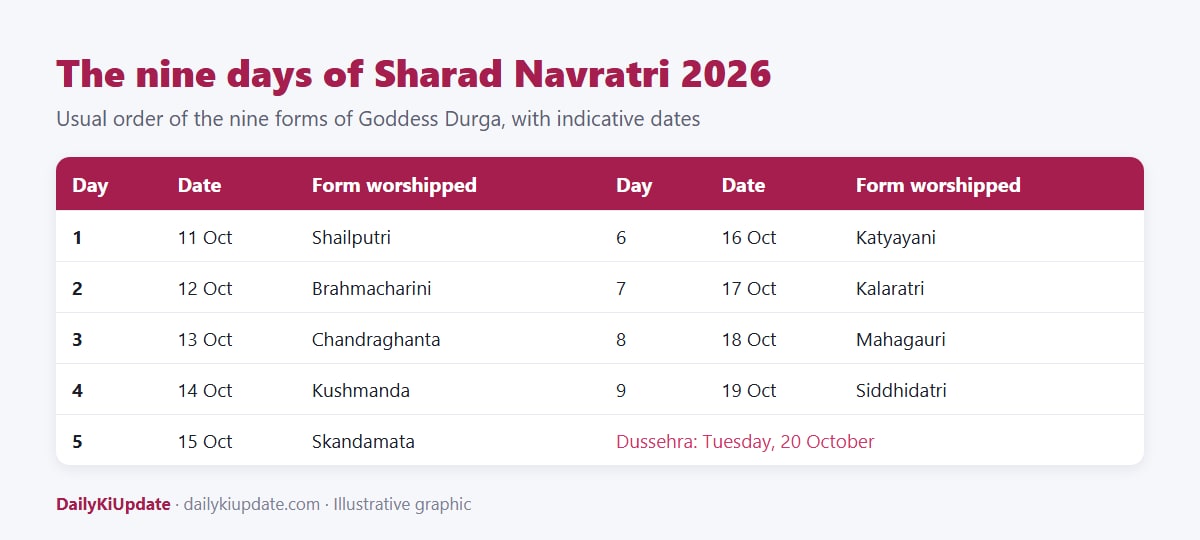
- Shailputri, daughter of the mountain. The day of Ghatasthapana, when the kalash is installed.
- Brahmacharini, associated with austerity and learning.
- Chandraghanta, the form with a crescent moon on the forehead.
- Kushmanda, linked in tradition with the creation of the universe.
- Skandamata, mother of Kartikeya (Skanda).
- Katyayani, the warrior form, popular in many north Indian traditions.
- Kalaratri, the fierce form that removes fear.
- Mahagauri, usually the day for Durga Ashtami and kanya pujan in many homes.
- Siddhidatri, the final day, often the day of Navami havan.
The colour of each day
Many families and temples follow a colour for each day. This is a custom, not a rule, and the sequence differs between regions. A commonly followed weekday-based scheme would look like this in 2026: Sunday orange (11 and 18 October), Monday white (12 and 19 October), Tuesday red (13 October), Wednesday blue (14 October), Thursday yellow (15 October), Friday green (16 October), Saturday grey (17 October). If your family or temple follows a different scheme, follow that.
Navratri fasting basics
Not everyone fasts, and the fast is practised in many ways: only on the first and last day, on all nine days, or by giving up grains but eating normally otherwise. The foods most commonly eaten in a vrat diet are:
- Kuttu (buckwheat) atta, singhara atta and sabudana
- Potatoes, sweet potatoes, pumpkin, bottle gourd
- Fruits, milk, curd and paneer
- Sendha namak (rock salt) instead of regular salt
Health note: if you have diabetes, blood pressure problems, are pregnant, or take regular medicines, speak to your doctor before a long fast. Buckwheat flour in particular is a common cause of food poisoning in the fasting season when it is stored badly, so buy fresh and from a sealed pack.
Kanya pujan on Ashtami and Navami
On the eighth or ninth day, many households invite young girls, often nine of them, to be worshipped as forms of the goddess. They are offered a meal, commonly puri, halwa and kala chana, and given small gifts. Plan ahead: with the Ashtami and Navami dates varying slightly by place, confirm the day with your local Panchang and invite guests in advance.
How Navratri differs across India
- Gujarat and western India: nightly Garba and Dandiya.
- West Bengal, Odisha, Assam and Bihar: Durga Puja, with elaborate pandals and the main days being Shashthi to Dashami.
- North India: fasting, kanya pujan, and Ramlila performances that end with Ravan Dahan on Dussehra.
- South India: Golu, the display of dolls on steps, and Saraswati and Ayudha Puja around the last days.
- Mysuru, Karnataka: the grand Dasara celebrations.
Dussehra on 20 October
Dussehra marks the victory of good over evil: Rama over Ravana in the Ramayana tradition and Durga over Mahishasura in the other. In many cities, towering effigies of Ravana, Kumbhakarna and Meghnad are burnt in the evening. If you are going to a public Ravan Dahan, arrive early, keep children close and follow local safety instructions.
Frequently asked questions
When does Navratri start in 2026?
Sharad Navratri starts on Sunday, 11 October 2026.
When is Dussehra in 2026?
Tuesday, 20 October 2026.
How many days is Navratri in 2026?
Nine nights, from 11 to 19 October, followed by Dussehra on the tenth day.
Which Navratri is the most important?
Sharad Navratri (October) is the most widely celebrated. Chaitra Navratri (March or April) is the second major Navratri of the year.
Can I drink tea and coffee while fasting?
Customs differ. Many people do have tea, coffee or milk during a Navratri fast, while some avoid them. Follow your family's practice.
Sources to verify
- Drik Panchang for city-specific tithi and puja timings.
- Your local temple or family Panchang for Ashtami, Navami and havan timings.