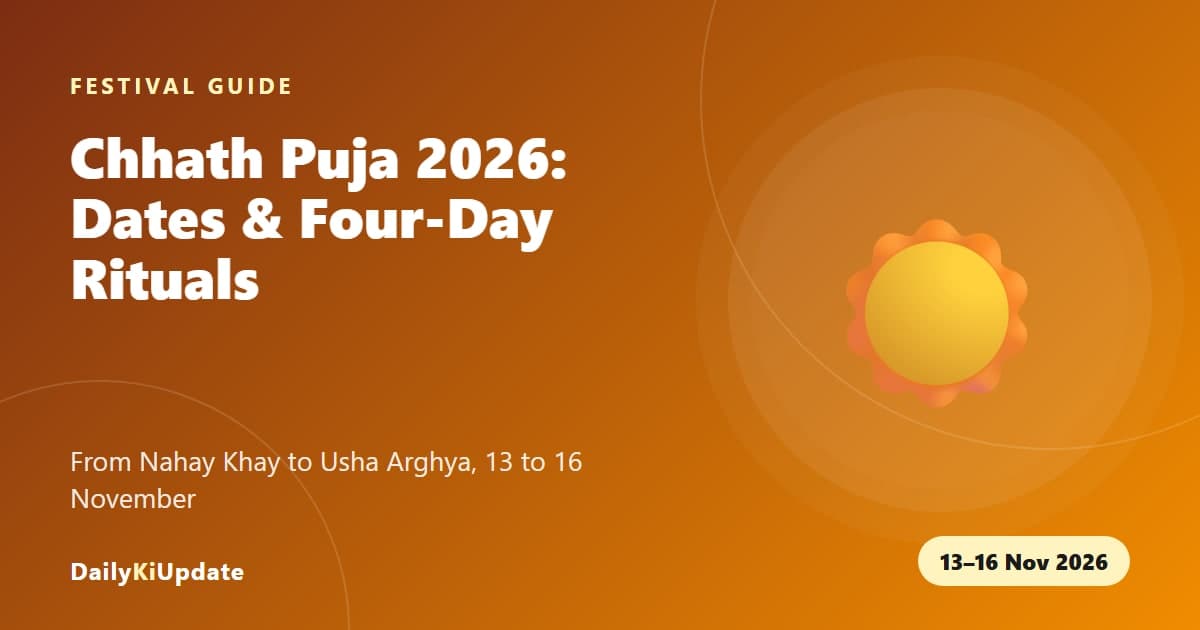
Chhath Puja 2026 begins on Friday, 13 November and ends on Monday, 16 November. The main day, Sandhya Arghya (the evening offering to the setting sun), is on Sunday, 15 November. It comes a few days after Diwali and is one of the most important festivals in Bihar, Jharkhand, eastern Uttar Pradesh and Nepal's Terai, and it is also widely celebrated by the diaspora across India.
Chhath is dedicated to Surya (the Sun god) and Chhathi Maiya. Devotees, called parvaiti, keep one of the most demanding fasts in the Hindu calendar, including a roughly 36-hour waterless fast. This is a plain guide to the four days and what to prepare.
Chhath Puja 2026 dates
| Day | Date | Ritual |
|---|---|---|
| Day 1 | Friday, 13 November 2026 | Nahay Khay |
| Day 2 | Saturday, 14 November 2026 | Kharna (Lohanda) |
| Day 3 | Sunday, 15 November 2026 | Sandhya Arghya |
| Day 4 | Monday, 16 November 2026 | Usha Arghya and parana |
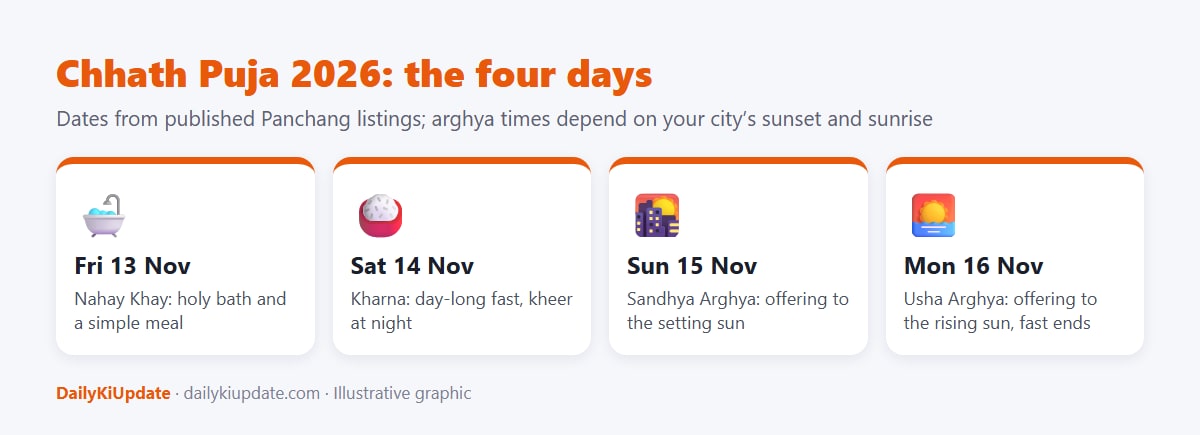
What happens on each day
Day 1: Nahay Khay
The parvaiti takes a bath, traditionally in a river or pond or with Ganga water at home, and the house is cleaned thoroughly. The first meal is simple and cooked in a clean kitchen: typically rice, chana dal and lauki (bottle gourd), made with rock salt and ghee, without onion or garlic.
Day 2: Kharna
The parvaiti fasts through the day without food or water. After sunset, prasad is prepared, usually kheer made from rice and jaggery, along with rotis or puris, and eaten after a small puja. Family and neighbours are often invited to receive this prasad. After this meal, the 36-hour waterless fast starts.
Day 3: Sandhya Arghya
This is the biggest day. Through the day the family prepares the prasad, which includes thekua (a sweet fried cookie made of wheat flour and jaggery), seasonal fruits and sugarcane. The offerings are arranged in a bamboo basket called a soop or daura. In the late afternoon, the family goes to the riverbank, pond or home-made water tank, and the parvaiti stands in water to offer arghya to the setting sun. Exact sunset time depends on your city, so check a local table.
Day 4: Usha Arghya
Before dawn, devotees go back to the water's edge and offer arghya to the rising sun. After the puja, the parvaiti breaks the fast with water and prasad, called parana. Prasad is then distributed to family, friends and neighbours.
Chhath prasad checklist
- Thekua and rice-flour laddoos (kasar)
- Seasonal fruits: bananas, apples, oranges, pomelo (sutha) and coconut
- Sugarcane stalks
- Bamboo soop and dalia (baskets), diyas, and new clean clothes
- Ghee, jaggery, wheat flour and rock salt for cooking
Ghat safety tips
Chhath ghats get very crowded around sunset and sunrise. A few sensible precautions:
- Go early and avoid crowded steps. Keep children and the elderly with a responsible adult at all times.
- Do not go into deep water, especially after a long fast when you may feel weak. Follow barricades and the instructions of volunteers or local authorities.
- Take a dry change of clothes, a towel and some warm layers. November mornings can be cold in north India.
- Be careful with diyas and lamps on bamboo baskets and keep them away from clothing.
- Do not litter. Many cities ask families to take away puja waste or use designated bins.
Health note for those fasting
The 36-hour waterless fast is hard on the body. People with diabetes, blood pressure problems, kidney issues or pregnancy should speak to a doctor first. Have water and a small amount of food ready at home for parana, and break the fast slowly.
Frequently asked questions
When is Chhath Puja in 2026?
13 to 16 November 2026, with the main Sandhya Arghya on Sunday, 15 November.
What is Nahay Khay?
The first day of Chhath, when devotees bathe and eat a single, simple, pure meal.
Why is thekua made for Chhath?
It is the traditional prasad, made from wheat flour, jaggery and ghee. It keeps well and is offered along with seasonal fruits.
Can anyone observe Chhath?
Yes. Both men and women keep the fast, though in practice women are the majority of parvaitis in most communities.
What time is the arghya?
It depends on sunset and sunrise in your city. Use your local Panchang or a sunrise and sunset table.
Sources to verify
- Drik Panchang: city-wise sunrise and sunset times
- National Disaster Management Authority: crowd and water safety guidance
Customs differ by family and region. Dates were compared across several published Panchang listings on 7 October 2026.