GraphQL vs REST in 2026: Choosing the Right API Style
When building a modern web or mobile application, one of the most important architecture decisions is how the frontend communicates with the backend.
Two API styles continue to appear in real-world projects: REST and GraphQL.
REST has been the dominant approach for web APIs for years. GraphQL introduced a different model where clients can request the fields and relationships they need through a typed schema.
But in 2026, the question is no longer simply:
"Is GraphQL better than REST?"
The more useful question is:
"Which API style fits this application's requirements?"
GraphQL can be useful when clients need flexible data requirements, multiple related resources, and a strongly typed API contract. REST can be a better fit when resource-oriented URLs, HTTP semantics, straightforward caching, and simple operational behavior are important.
This guide compares GraphQL vs REST in 2026, including architecture, performance, caching, security, mobile applications, scalability, developer experience, and practical use cases.
What Is REST?
REST stands for Representational State Transfer.
REST is an architectural style built around resources and standard HTTP semantics.
For example, an application might expose endpoints such as:
GET    /api/users
GET    /api/users/123
POST   /api/users
PUT    /api/users/123
PATCH  /api/users/123
DELETE /api/users/123
Each URL identifies a resource or collection, while the HTTP method describes the operation.
For example:
GET /api/products/123
might return:
{
  "id": 123,
  "name": "Laptop",
  "price": 79999,
  "category": "Electronics"
}
HTTP itself defines semantics for methods such as GET, POST, PUT, PATCH, and DELETE, and GET responses can be cached when the relevant HTTP caching conditions are satisfied.
REST therefore works naturally with the existing HTTP ecosystem:
URLs
HTTP methods
status codes
headers
caches
proxies
CDNs
authentication middleware
monitoring tools
What Is GraphQL?
GraphQL is a query language and API specification that allows clients to request the data they need from a strongly typed schema.
Instead of having many resource-specific endpoints, a GraphQL API commonly exposes an endpoint such as:
POST /graphql
The client sends a query describing the requested fields.
For example:
query {
  user(id: "123") {
    id
    name
    email
  }
}
The response can contain exactly those requested fields:
{
  "data": {
    "user": {
      "id": "123",
      "name": "Rajendra",
      "email": "user@example.com"
    }
  }
}
GraphQL's schema defines what clients can request, and its query model allows clients to traverse related objects and select specific fields.
GraphQL supports three primary operation types:
query
mutation
subscription
Queries are generally used for reading data, mutations for changing data, and subscriptions for supported real-time use cases.
GraphQL vs REST: The Core Difference
The biggest conceptual difference is how the API defines the data request.
REST
The server generally defines the shape of each endpoint response.
GET /api/products/123
The endpoint may return:
{
  "id": 123,
  "name": "Laptop",
  "price": 79999,
  "description": "...",
  "images": [],
  "reviews": [],
  "seller": {}
}
The client may only need:
id
name
price
but still receives additional fields depending on the API design.
GraphQL
The client explicitly selects the fields:
query {
  product(id: "123") {
    id
    name
    price
  }
}
This difference becomes particularly useful when different clients need different representations of the same underlying data.
GraphQL vs REST Example
Imagine an e-commerce application.
A product details screen needs:
product information
seller information
reviews
related products
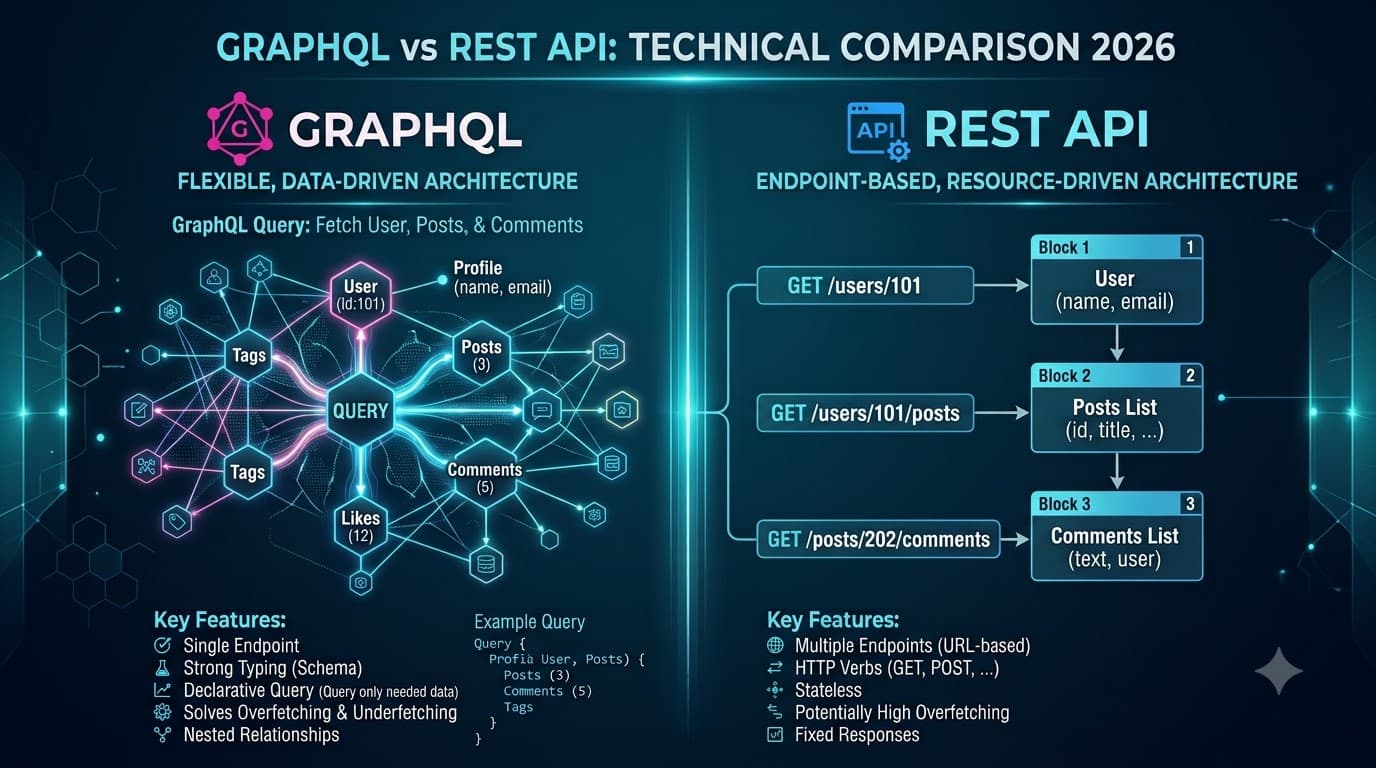
With REST, you might make several requests:
GET /products/123
GET /products/123/seller
GET /products/123/reviews
GET /products/123/related
Depending on the API design, the frontend may need to coordinate these requests.
With GraphQL, related data can be requested through one operation:
query {
  product(id: "123") {
    id
    name
    price

    seller {
      id
      name
    }

    reviews {
      rating
      comment
    }

    relatedProducts {
      id
      name
      price
    }
  }
}
GraphQL is designed to allow clients to traverse related objects and request the fields they need, which can reduce the need for multiple application-level fetches in suitable data models.
However, this does not mean every GraphQL request is automatically faster than REST. Backend resolver design, database queries, network conditions, caching, authorization, and payload size still determine real-world performance.
GraphQL vs REST: Feature Comparison
Area | REST | GraphQL |
|---|---|---|
API model | Resource-oriented | Schema/query-oriented |
Endpoints | Usually multiple | Often one main endpoint |
Data selection | Server-defined responses | Client selects fields |
HTTP semantics | Central to API design | Often uses HTTP as transport |
Typed schema | Optional/varies | Core feature |
Nested data | Usually separate endpoints or custom responses | Natural in queries |
Caching | Strong HTTP ecosystem | Requires deliberate strategy |
Over-fetching | Possible | Can often be reduced |
Under-fetching | Possible | Can often be reduced |
Tooling | Mature | Strong schema/codegen tooling |
Learning curve | Generally straightforward | Higher conceptual overhead |
CDN caching | Straightforward for GET-based APIs | More involved |
Mobile clients | Works well | Flexible for varying screens |
File uploads | Straightforward with conventional HTTP patterns | Usually requires additional conventions |
API versioning | Often URL/header based | Schema evolution/deprecation |
Monitoring | Endpoint-oriented | Operation/query-aware monitoring is useful |
Neither model is universally better.
The correct choice depends on the API's consumers, data relationships, infrastructure, performance requirements, and team experience.
1. API Flexibility
One of GraphQL's biggest advantages is client-controlled field selection.
Consider a mobile application:
query {
  user(id: "123") {
    id
    name
    avatar
  }
}
A desktop dashboard might request:
query {
  user(id: "123") {
    id
    name
    email
    avatar
    orders {
      id
      total
      status
    }
  }
}
The same API can support both use cases without necessarily creating separate endpoints for each UI.
GraphQL's official documentation highlights flexible field selection and strongly typed schemas as major characteristics of the technology.
REST can also support flexible responses through query parameters, specialized endpoints, sparse fieldsets, or backend-for-frontend layers.
For example:
GET /users/123?fields=id,name,avatar
Therefore, flexible responses are not exclusive to GraphQL.
2. Over-Fetching and Under-Fetching
These are common arguments in favor of GraphQL.
Over-fetching
Over-fetching occurs when the client receives more data than it needs.
For example:
GET /api/users/123
returns:
{
  "id": 123,
  "name": "Rajendra",
  "email": "user@example.com",
  "phone": "...",
  "address": {},
  "preferences": {},
  "orders": [],
  "notifications": []
}
But the UI only needs:
name
avatar
GraphQL allows the client to request only the fields required:
query {
  user(id: "123") {
    name
    avatar
  }
}
Under-fetching
Under-fetching happens when the client needs multiple related resources but the API requires multiple requests.
For example:
GET /users/123
GET /users/123/orders
GET /users/123/notifications
GraphQL can represent these relationships in one query when the schema supports them.
This is particularly useful for complex dashboards and mobile applications.
3. Performance: GraphQL vs REST
There is no universal rule that GraphQL is faster than REST or that REST is faster than GraphQL.
Performance depends heavily on implementation.
A well-designed REST API can be extremely fast.
A poorly designed GraphQL API can be slow.
For example, GraphQL can accidentally trigger excessive database queries through inefficient resolvers.
Suppose:
query {
  users {
    id
    name
    posts {
      id
      title
    }
  }
}
If the server performs one database query for every user's posts, a large user list could create an N+1 query problem.
A common solution is batching and request-level caching, often implemented using tools such as DataLoader-style patterns.
The important lesson is:
GraphQL reduces data-fetching problems at the API contract level, but it does not automatically optimize your database.
4. Caching
Caching is one of the areas where REST often has a simpler model.
With REST:
GET /api/products/123
has a stable URL.
That makes it natural to use:
browser caches
reverse proxies
CDN caches
HTTP cache headers
ETags
Cache-Control
conditional requests
HTTP explicitly defines caching semantics, and GET responses are cacheable unless caching is restricted by the response or request conditions.
GraphQL commonly uses a POST request such as:
POST /graphql
with the query in the request body.
Caching then requires more deliberate architecture.
Possible strategies include:
persisted queries
operation-based caching
normalized client caches
CDN-specific GraphQL caching
response caching
server-side caching
cache keys based on operation and variables
GraphQL does have powerful caching options, but HTTP caching is generally more straightforward when resources map cleanly to GET URLs.
5. API Versioning
REST APIs commonly use versioning patterns such as:
/api/v1/users
/api/v2/users
or headers such as:
Accept: application/vnd.example.v2+json
The exact strategy depends on the organization.
GraphQL generally approaches API evolution differently.
Instead of creating:
/graphql/v1
/graphql/v2
teams can evolve the schema by adding fields and deprecating older fields.
For example:
type User {
  id: ID!
  name: String!
  username: String @deprecated(reason: "Use handle")
  handle: String
}
This can allow clients to migrate gradually.
GraphQL's official documentation specifically describes deprecation as part of its approach to reducing the need for breaking changes.
That does not mean GraphQL cannot have breaking changes. Poor schema governance can still create breaking changes.
6. Type Safety
GraphQL has a built-in type system.
For example:
type Product {
  id: ID!
  name: String!
  price: Float!
  inStock: Boolean!
}
The schema tells clients what fields and types are available.
This can be especially useful with TypeScript.
A typical workflow might be:
GraphQL Schema
      ↓
Code Generation
      ↓
TypeScript Types
      ↓
React / React Native
The result can provide stronger alignment between frontend code and the API contract.
REST APIs can also provide strong typing using:
OpenAPI
JSON Schema
generated TypeScript clients
contract testing
Therefore, GraphQL does not have a monopoly on typed APIs.
7. Error Handling
REST commonly uses HTTP status codes:
200 OK
201 Created
400 Bad Request
401 Unauthorized
403 Forbidden
404 Not Found
409 Conflict
500 Internal Server Error
This fits naturally with HTTP.
GraphQL commonly returns a response with:
{
  "data": {
    "user": null
  },
  "errors": [
    {
      "message": "User not found"
    }
  ]
}
GraphQL defines top-level data and errors concepts for operation results.
This model allows partial data and errors to coexist.
For example, one field may succeed while another field fails.
That can be useful for complex screens, but it also means teams need clear conventions for:
authentication errors
authorization errors
validation errors
business errors
infrastructure errors
partial responses
8. Security
Neither REST nor GraphQL is automatically more secure.
Security depends on implementation.
Both require:
authentication
authorization
input validation
rate limiting
logging
monitoring
secure secrets
HTTPS
abuse prevention
GraphQL introduces additional concerns because clients can construct complex queries.
For example:
query {
  users {
    posts {
      comments {
        author {
          posts {
            comments {
              ...
            }
          }
        }
      }
    }
  }
}
Without proper controls, deeply nested queries can consume significant resources.
GraphQL APIs may therefore use:
query depth limits
query complexity limits
persisted queries
operation allowlists
rate limiting
pagination limits
maximum result sizes
authorization at resolver/field boundaries
REST APIs have their own abuse cases, including expensive endpoints, unrestricted filters, excessive pagination, and resource-intensive operations.
Security should therefore be treated as an API architecture concern rather than a simple GraphQL-vs-REST choice.
9. Mobile Applications
GraphQL can be particularly useful when the same backend serves multiple mobile and web clients.
Imagine:
Android
iOS
Web
Admin Dashboard
Each client may require a different subset of data.
With GraphQL, clients can request their required fields without necessarily requiring a new endpoint for every screen.
For example:
query HomeScreen {
  currentUser {
    name
    avatar
  }

  featuredProducts {
    id
    name
    price
    image
  }

  notifications(limit: 5) {
    id
    title
  }
}
This can be convenient for mobile applications where bandwidth and request coordination matter.
However, REST remains a strong option for mobile apps, especially when the API is simple, cache-friendly, and already well designed.
10. Real-Time Applications
GraphQL supports subscriptions as an operation type.
For example:
subscription {
  messageCreated {
    id
    text
    sender {
      id
      name
    }
  }
}
This can provide a schema-driven interface for real-time data.
However, GraphQL subscriptions are not the only real-time solution.
REST APIs are commonly combined with:
WebSockets
Server-Sent Events
Webhooks
polling
For many applications, a REST API plus WebSocket channel can be simpler than introducing GraphQL subscriptions.
The correct architecture depends on the real-time requirements.
11. Developer Experience
REST is familiar to most developers.
A typical REST request looks like:
const response = await fetch("/api/products/123");

const product = await response.json();
GraphQL requires understanding concepts such as:
schemas
queries
mutations
fragments
variables
resolvers
directives
query validation
operation names
Example:
const query = `
  query Product($id: ID!) {
    product(id: $id) {
      id
      name
      price
    }
  }
`;

const response = await fetch("/graphql", {
  method: "POST",
  headers: {
    "Content-Type": "application/json"
  },
  body: JSON.stringify({
    query,
    variables: {
      id: "123"
    }
  })
});
GraphQL's ecosystem also provides schema-aware tooling, editor integrations, linting, analytics, and code generation.
So GraphQL has a higher initial learning curve but can provide strong tooling once the architecture is established.
12. GraphQL Is Not a Database
A common misconception is that GraphQL replaces your database.
It does not.
GraphQL is an API technology and can sit in front of different data sources.
For example:
                 GraphQL API
                     |
       +-------------+-------------+
       |             |             |
   PostgreSQL       Redis        REST API
       |             |             |
    Database       Cache       External Service
Resolvers can retrieve data from databases, services, APIs, or other systems.
The official GraphQL documentation explicitly notes that GraphQL is not a database language and is independent of the underlying data source.
13. Microservices and GraphQL
GraphQL can also work as an aggregation layer.
Imagine a company with:
User Service
Product Service
Order Service
Payment Service
Review Service
A frontend might otherwise communicate with several services.
A GraphQL gateway can expose a unified API:
                    Web / Mobile
                         |
                    GraphQL API
                         |
       +---------+-------+-------+---------+
       |         |       |       |         |
     Users    Products Orders Payments Reviews
This can simplify the client-side API contract.
But it introduces additional infrastructure and operational complexity.
GraphQL should not automatically be introduced simply because an organization uses microservices.
A well-designed REST gateway or backend-for-frontend architecture can solve similar problems.
14. When REST Is a Good Choice
REST is often a natural choice when your application has:
Simple CRUD operations
For example:
GET /products
GET /products/:id
POST /products
PATCH /products/:id
DELETE /products/:id
Strong HTTP caching requirements
If resources map cleanly to URLs and CDN caching is important, REST can be straightforward.
Public APIs
REST APIs are familiar to a large developer audience and can be easy to document and consume.
Simple data relationships
If clients usually need complete resource representations, GraphQL's field-selection flexibility may not provide enough benefit to justify its additional complexity.
Existing REST infrastructure
If your organization already has:
OpenAPI
API gateways
monitoring
caching
authentication middleware
SDK generation
then replacing REST simply because GraphQL is popular may create unnecessary migration cost.
15. When GraphQL Is a Good Choice
GraphQL can be a strong fit when:
Multiple clients need different data
For example:
Web
iOS
Android
Smart TV
Admin
Data is highly connected
For example:
User
 ├── Orders
 │    └── Products
 └── Reviews
      └── Products
Frontend teams need flexible queries
GraphQL allows clients to select fields based on the screen or component.
You need a strongly typed API contract
GraphQL schemas can provide a common contract between frontend and backend teams.
You have a mature API team
GraphQL works best when teams understand:
resolver design
caching
authorization
query complexity
schema evolution
observability
N+1 prevention
16. GraphQL vs REST for React
Both work well with React.
A REST-based React application might use:
const response = await fetch("/api/products");
const products = await response.json();
A GraphQL application might use a GraphQL client such as Apollo Client, Relay, or another implementation.
Conceptually:
React
  ↓
GraphQL Client
  ↓
GraphQL API
  ↓
Resolvers
  ↓
Database / Services
The advantage is that React components can often describe their data requirements close to the UI.
For example:
query ProductCard($id: ID!) {
  product(id: $id) {
    id
    name
    price
    image
  }
}
This can be useful in large applications where different screens require different combinations of data.
17. GraphQL vs REST for React Native
React Native applications can benefit from both API styles.
GraphQL can be attractive when:
network requests need to be carefully controlled
screens require related data
iOS and Android screens have different requirements
the API serves both web and mobile
offline or normalized client caching is important
REST can be attractive when:
endpoints are simple
HTTP caching is valuable
backend infrastructure is already REST-based
the application mainly performs straightforward CRUD operations
The mobile platform itself does not determine the API style.
The application's data requirements should drive the decision.
18. GraphQL vs REST for Next.js
Next.js applications can also use either approach.
REST:
Next.js
   ↓
REST API
   ↓
Backend
GraphQL:
Next.js
   ↓
GraphQL API
   ↓
Resolvers
   ↓
Backend services
The important question is not whether Next.js supports GraphQL or REST.
It supports both.
Instead, consider:
server-side data fetching
caching strategy
authentication
API ownership
frontend requirements
backend architecture
deployment model
observability
19. GraphQL and REST Can Coexist
You do not have to choose only one.
A production architecture can use both.
For example:
                    Frontend
                       |
              +--------+--------+
              |                 |
          GraphQL              REST
              |                 |
        Internal Data      External APIs
              |                 |
        Microservices      Third-Party APIs
GraphQL can even act as an abstraction layer over existing REST APIs.
For example:
GraphQL Resolver
      ↓
REST API
      ↓
External Service
The GraphQL documentation explicitly notes that GraphQL and REST can coexist and that REST endpoints can be exposed through GraphQL resolvers.
This can be useful when gradually modernizing an existing system.
20. Common GraphQL Mistakes
GraphQL is powerful, but poor implementation can create problems.
1. Ignoring N+1 queries
Always understand what each resolver does at the database level.
2. Unlimited query depth
A client should not be able to generate arbitrarily expensive queries.
3. No pagination
Avoid returning thousands of records by default.
Prefer:
products(first: 20) {
  nodes {
    id
    name
  }
}
4. Weak authorization
Do not assume that hiding a field from the UI provides security.
Authorization must be enforced on the server.
5. Poor schema design
A GraphQL schema is an API contract.
Treat it as a long-term product rather than simply exposing database tables.
6. No observability
Track:
operation names
latency
errors
resolver performance
database performance
query complexity
21. Common REST Mistakes
REST also has architectural pitfalls.
1. Endpoint explosion
Creating separate endpoints for every UI screen can make the API difficult to maintain.
2. Inconsistent response formats
For example:
{
  "data": {}
}
on one endpoint and:
{
  "result": {}
}
on another.
Consistency matters.
3. Poor HTTP semantics
HTTP methods and status codes should communicate meaningful behavior.
4. Returning huge payloads
Do not return an entire database object when the client only needs a small representation.
5. Ignoring caching
For cacheable public or semi-public resources, proper HTTP caching can significantly improve efficiency.
HTTP's semantics are specifically designed to support intermediaries and caching behavior.
22. How to Choose in 2026
Instead of asking:
"Is GraphQL better than REST?"
ask these questions.
Question 1: How many clients do you have?
If you have:
Web
iOS
Android
Admin
Partner API
GraphQL may provide useful flexibility.
If you have one simple web client, REST may be sufficient.
Question 2: How connected is your data?
Simple:
User → Profile
REST can be straightforward.
Complex:
User
 ├── Orders
 │    ├── Products
 │    └── Payments
 ├── Reviews
 └── Recommendations
GraphQL's graph-based query model may become more useful.
Question 3: How important is HTTP caching?
If your application heavily depends on:
CDN caching
browser caching
HTTP cache headers
resource URLs
REST may provide a simpler architecture.
Question 4: How flexible are client requirements?
If different clients constantly require different fields, GraphQL can reduce the need for specialized response endpoints.
Question 5: Does your team understand GraphQL operations?
If the team is unfamiliar with:
schema design
resolvers
query complexity
caching
N+1 queries
authorization
introducing GraphQL can increase complexity.
Question 6: Do you already have a mature REST API?
If yes, migration should have a measurable reason.
GraphQL is not automatically a reason to replace a functioning REST API.
GraphQL vs REST Decision Checklist
Use this checklist before choosing.
Choose REST when:
Your API is mostly simple CRUD
Resources map naturally to URLs
HTTP caching is important
Your API is public and conventional
Your existing infrastructure is REST-based
You want minimal architectural complexity
Clients generally need predictable resource representations
Consider GraphQL when:
Multiple clients need different fields
Data relationships are complex
Clients frequently need nested data
A strongly typed schema is valuable
Frontend teams need flexible data selection
You can operate GraphQL securely at scale
Your team understands resolver and schema design
Consider both when:
You have existing REST services
You need GraphQL for selected frontend use cases
Third-party APIs are REST-based
You are gradually modernizing an existing platform
Different API consumers have different requirements
GraphQL vs REST: A Practical Architecture
For a modern application, the decision can look like this:
                    Clients
          +-----------+-----------+
          |           |           |
         Web         iOS        Android
          |           |           |
          +-----------+-----------+
                      |
                 API Layer
                      |
              +-------+-------+
              |               |
           GraphQL           REST
              |               |
        Internal Data    External APIs
              |               |
        Service Layer     Third Party
              |
        Database / Cache
There is nothing wrong with having more than one API style when each has a clear responsibility.
The goal is not to use the newest technology.
The goal is to create an API that is:
predictable
secure
observable
maintainable
performant
easy for clients to consume
Final Verdict: GraphQL vs REST in 2026
GraphQL and REST solve similar API problems through different models.
REST works around resources and HTTP semantics. It is familiar, cache-friendly, straightforward, and often an excellent fit for conventional APIs.
GraphQL provides a typed schema and allows clients to request specific fields and relationships. It can be especially useful for applications with multiple clients and complex data requirements.
The important point is that GraphQL is not a replacement for REST in every application. The GraphQL project itself describes GraphQL and REST as technologies that can coexist rather than treating GraphQL as a definitive replacement.
For a new project, evaluate:
Client requirements
       ↓
Data relationships
       ↓
Caching requirements
       ↓
Security requirements
       ↓
Team expertise
       ↓
Infrastructure
       ↓
Choose API style
The best API architecture is the one that solves the application's actual requirements without introducing unnecessary complexity.
Frequently Asked Questions
Is GraphQL better than REST in 2026?
Neither is universally better. GraphQL is useful for flexible, typed data access and complex client requirements, while REST can be simpler for resource-oriented APIs, HTTP caching, and conventional CRUD applications.
Is GraphQL faster than REST?
Not automatically. Performance depends on the implementation, database access, caching, network conditions, payload size, resolver design, and infrastructure.
Can GraphQL and REST be used together?
Yes. A system can use GraphQL for frontend clients while continuing to use REST services internally or for third-party integrations.
Is GraphQL good for mobile applications?
It can be. Its ability to let clients request specific fields can be useful when mobile screens have different data requirements. REST can also work extremely well for mobile applications.
Does GraphQL replace REST APIs?
No. GraphQL is an alternative API approach, not a mandatory replacement. Both technologies can coexist in the same architecture.
Is GraphQL a database?
No. GraphQL is an API technology and can work with databases, REST services, microservices, and other data sources.
Which is easier to learn, REST or GraphQL?
REST is generally easier to understand initially because it maps naturally to HTTP requests, URLs, methods, and status codes. GraphQL introduces schemas, queries, mutations, resolvers, and additional concepts.
Should a startup use GraphQL?
There is no universal answer. A startup should consider team expertise, client requirements, data complexity, caching, infrastructure, and long-term maintenance before choosing an API architecture.
Key Takeaways
REST is resource-oriented and closely aligned with HTTP.
GraphQL is schema-oriented and client-driven.
GraphQL can reduce over-fetching and under-fetching in suitable applications.
REST generally has a simpler HTTP caching model.
GraphQL provides a strong type system and flexible queries.
GraphQL requires careful resolver, authorization, caching, and query-complexity design.
REST and GraphQL can coexist.
Neither technology is automatically faster or better.
Choose based on application requirements rather than technology trends.