When rain interrupts a limited-overs cricket match, the scoreboard suddenly shows a target that does not seem to make sense. "How can a team need only 162 in 20 overs when the other team made 180 in 20 overs?" Behind the confusion is the Duckworth-Lewis-Stern (DLS) method, the system the ICC uses to set fair targets in shortened matches. It is easier to understand than it looks, if you get one idea first: DLS is about resources, not run rate.
The big idea: resources
A batting side has two things to score runs with: overs remaining and wickets in hand. DLS calls the combination of these two the team's resources, expressed as a percentage. At the start of a 50-over innings, a team has 100% of its resources: 50 overs and 10 wickets.
As overs are used and wickets fall, the resource percentage drops. But the two do not drop at the same rate. Losing wickets early costs more than losing wickets late, and losing overs when you have many wickets in hand costs more than losing overs when you have few. The ICC's computer-based tables (or software) calculate how much of the resources each combination of overs and wickets represents.
A simple worked example
These numbers are hypothetical and are chosen to make the idea clear. The actual DLS software uses the ICC's tables, which are updated as scoring patterns evolve.
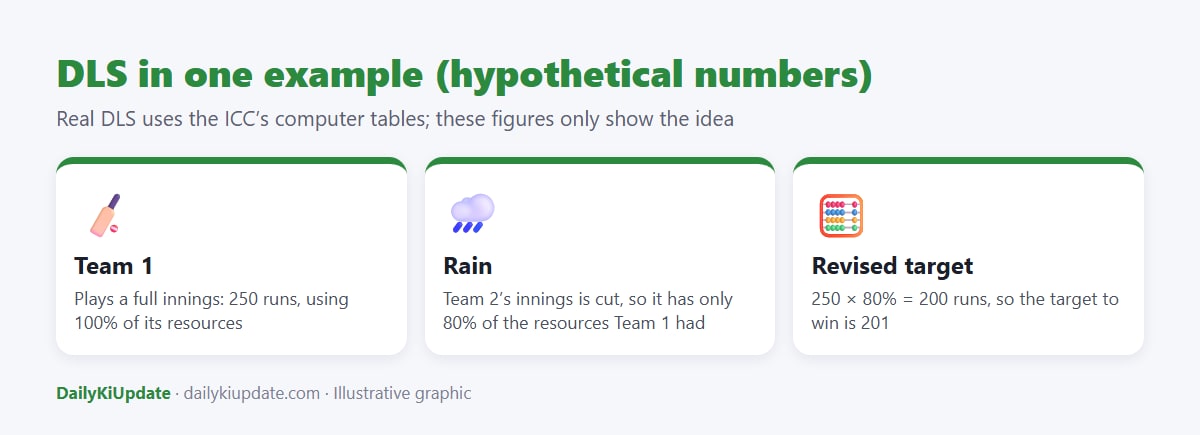
- Team 1 bats a full 50 overs and scores 250. It used 100% of its resources.
- Rain arrives, and Team 2's innings is shortened. After considering the overs available, Team 2 has only 80% of the resources Team 1 had.
- The revised score to match is 250 × 80% = 200. To win, Team 2 needs 201, which is one more.
If Team 2 had more resources than Team 1, say because Team 1's innings was cut short, then the target would be raised using an additional factor (the "G50" or "G" value) that reflects average scoring in the format.
What happens if rain stops play mid-chase?
Suppose Team 2 is 100/2 after 20 overs when rain comes and the match is later reduced to 40 overs. The umpires and match referee enter the interruption into the DLS software, which calculates the resources lost from the stoppage on the basis of when it happened and how many wickets were down. The new target is recalculated for the revised number of overs. If the match cannot continue, the result is based on the par score: the score Team 2 should have reached at that stage, given the wickets lost.
- If Team 2 is ahead of par, Team 2 wins.
- If Team 2 is behind par, Team 1 wins.
- If the scores equal par exactly, the match is a tie.
Target vs par score: a common confusion
| Term | Meaning |
|---|---|
| Target | The score Team 2 must beat to win at the end of the revised innings |
| Par score | The score Team 2 should have at a given moment, given the wickets lost, if the game stops there |
| Resources | Combination of overs and wickets left, shown as a percentage |
| Revised overs | New innings length after interruptions |
Minimum overs needed for a result
For a DLS result to be valid, each team must face a minimum number of overs. As of the ICC playing conditions, this is 20 overs per side in ODIs and 5 overs per side in T20Is (for the chasing team), though tournament-specific playing conditions can differ, and in some cases (such as knockout games) organisers may require more overs. Check the event's playing conditions for the exact limit.
Why DLS targets sometimes look strange
- Wickets matter. A team 100/8 has much fewer resources than a team 100/2, even at the same score.
- A higher run rate does not guarantee a win. Overs and wickets are balanced against each other. Rapid scoring early but a lost wicket costs resources.
- Interruptions timing. A stoppage when the batting team has many wickets in hand and aggressive batting ahead costs more than a stoppage late in the innings.
- The tables are updated. Because T20s and ODIs are now higher-scoring, the ICC updates the average score used in the model.
Where the method comes from
The method was devised by English statisticians Frank Duckworth and Tony Lewis and first used in international cricket in 1997. After Duckworth and Lewis retired, Australian academic Professor Steven Stern took over and the method was renamed Duckworth-Lewis-Stern in 2014. It replaced older methods that were considered unfair, such as simply comparing run rates or removing the "least productive overs" from the first innings.
Is DLS fair?
No method is perfect, but DLS has been widely accepted as more reasonable than the alternatives. Critics point out that it can be hard to follow, that some teams find it easier to chase under it, and that the model rests on past scoring patterns rather than the match situation, the pitch or the specific batters. Supporters say it accounts for the central trade-off between overs and wickets, which simpler methods ignore.
Frequently asked questions
What does DLS stand for?
Duckworth-Lewis-Stern.
Is DLS only used when it rains?
It is used whenever an interruption, such as rain, bad light or a similar delay, shortens a limited-overs match.
Why is the target sometimes lower than the first innings score?
Because the chasing team has fewer resources, usually fewer overs, so the target is scaled down.
Who calculates DLS?
The match officials use ICC-approved DLS software. The calculation is done by computer, not by hand.
Is DLS used in the IPL?
Yes. It is used in IPL matches if an interruption shortens an innings, subject to the tournament's playing conditions.
Sources to verify
The worked example is hypothetical, for explanation only. Real DLS calculations use the ICC's official software.